
Choosing where to rent an Office Space London is one of the most significant decisions a business can make. It’s a choice that goes far beyond a postcode and a monthly price. The right Office Space London can define your company culture, shape client perceptions, and fundamentally influence your trajectory. After spending over a decade observing London’s commercial property London landscape, I’ve witnessed firsthand how an address can become a strategic asset rather than just a location.
To illustrate this profound truth, I’m comparing two distinct properties that couldn’t be more different: a corporate high-rise office in the bustling financial district of Canary Wharf and a tranquil, boutique office in historic St James’s. These aren’t just buildings—they’re business statements. The differences between them reveal deeper insights about how your flexible office space choice impacts everything from employee retention to client acquisition.
Ready to Find Your Perfect London Office?
Explore hundreds of verified office spaces across London’s most strategic locations
Browse Available Offices9 Surprising Truths Your Office Space London Reveals About Your Business
1. Vibe is a Strategic Choice, Not an Accident
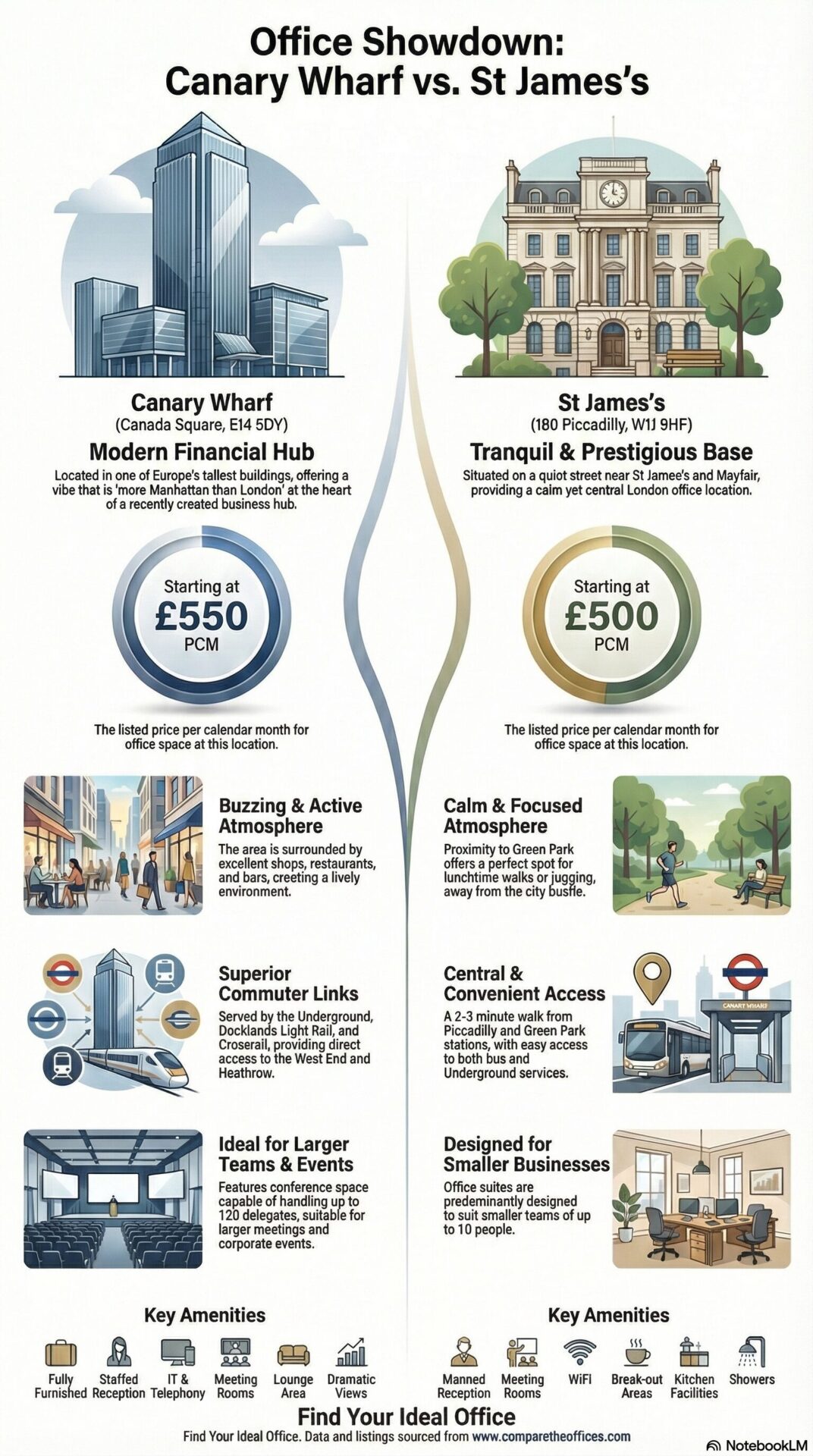
The atmosphere of your workplace directly impacts your team and your clients in ways that extend far beyond aesthetics. During my research visits, the contrast was striking. The Canary Wharf office is described as “buzzing with activity” and “more Manhattan than London,” creating a high-energy, fast-paced environment suited for businesses that thrive on dynamism and a sense of scale.
In stark contrast, the St James’s property offers a “tranquil central London office base” located on a “quiet street.” This fosters an atmosphere of calm, focus, and discretion, which might be ideal for deep work, creative thinking, or firms that value privacy and composed client interactions. The vibe you choose is a statement of your company’s operational tempo.
2. The Price Tag Tells Only Half the Story
At first glance, the serviced office costs appear comparable: £550 per calendar month for Canary Wharf and £500 PCM for St James’s. This marginal price delta of just £50, however, masks a profound divergence in the total occupational value and ecosystem you are investing in.
It’s not just about a desk and a chair; it’s about the scale of the operation, the target market, and the entire business ecosystem you are joining. When evaluating Office rental London options, I’ve learnt to calculate the hidden value—the intangible returns that never appear on an invoice.
3. Amenities Signal Your Business’s Ambition
The amenities on offer are a clear indicator of a business’s model and priorities. The Canary Wharf location boasts large-scale features, including conference space capable of handling up to 120 delegates. This signals an ambition for large corporate events, major client presentations, and extensive training sessions.
The St James’s property, however, focuses on team well-being and agility, providing shower facilities for a pre-work run, a self-service kitchen for team lunches, and break-out areas for informal collaboration. One is built for corporate projection; the other is designed for boutique efficiency and culture.
| Location | Key Amenities | Target Business Type |
|---|---|---|
| Canary Wharf | 120-person conference rooms, international-standard facilities | Corporate events, B2B sales |
| St James’s | Shower facilities, self-service kitchen, break-out areas | Boutique teams, wellness-focused |
4. “Serviced” Means Tailored Support
Both locations are prime examples of high-quality Serviced Offices London, but the support is tailored to their distinct clientele. The core offering is the same: a staffed or manned reception providing administrative support, which removes a significant operational burden.
In Canary Wharf, ‘administrative support’ likely means managing a high-flow of international visitors and coordinating complex multi-party meetings. In St James’s, it’s more likely to be a highly personalised service, acting as a virtual PA for a small leadership team, handling sensitive client communications with discretion.
Need Help Choosing the Right Office?
Our experts understand London’s office market inside out. Get personalised recommendations based on your business needs.
Speak to an Expert5. Your Postcode Dictates Your Team’s Lifestyle
An office is more than just a place to work; it’s the epicentre of your team’s daily life. The Canary Wharf building is surrounded by “excellent shops, restaurants and bars around its base,” offering a lifestyle of convenience and constant activity.
Conversely, the St James’s office is near “smart restaurants” and, crucially, “Green Park,” which the description notes is “an ideal place for a lunchtime stroll or to go jogging.” This choice is a reflection of company culture: do you offer a vibrant, all-in-one urban experience, or do you promote a culture of well-being and balance with access to green space?
6. Connectivity Has a Purpose
Both offices are exceptionally well-connected, but their transport links serve different strategic purposes. Canary Wharf’s connectivity via the Underground, DLR, and the new Crossrail provides “direct links to the West End and Heathrow.” This is built for a global business, prioritising international travel and major city-wide commutes.
The St James’s office, being a “2-3 min walk of both Piccadilly and Green Park stations,” offers superlative access within central London. This is perfect for a business whose clients, talent, and partners are primarily located within the capital itself.
7. It’s the Statement Skyscraper vs. the Discreet Boutique
The physical presence of your building makes an immediate and powerful statement. The Canary Wharf office occupies the “37th floor” of “one of the tallest buildings in Europe,” promising “dramatic views.” This is an undeniable projection of power, scale, and market dominance.
The St James’s property, by contrast, offers a more understated and exclusive presence, catering specifically to “smaller businesses of up to 10 people” within a traditional London streetscape. One says, “We are a major player”; the other says, “We are a specialist.”
8. Flexibility is the New Default
Despite their many differences, one key feature unites both properties: “Flexible Terms.” This highlights a fundamental shift in the commercial property market. This move towards adaptability is evident across the market, from dedicated desks in a Coworking space London to the bespoke suites in our examples.
Whether you’re a global corporation in a skyscraper or a ten-person team in St James’s, the ability to scale up or down without being locked into a rigid, long-term lease is no longer a perk but a necessity. Any search for a flexible office space in London should have this as a primary criterion.
9. Your Neighbours Shape Your Network
The companies you share a district with form your professional ecosystem. An office in the “heart of the Canary Wharf financial district” places you among major banks, financial services firms, and global corporations. This facilitates networking for large-scale B2B contracts and access to a deep talent pool in finance and law.
In St James’s, “a short walk from both St James’s and Mayfair,” your neighbours are more likely to be boutique private firms, hedge funds, and bespoke consultancies. The St James’s network is about building relationships with high-net-worth individuals, family offices, and sources of private capital, where influence is cultivated through discretion rather than scale.
Discover Your Ideal London Office Today
Compare verified office spaces across Canary Wharf, St James’s, and 50+ London locations
Start Your SearchConclusion: What Does Your Office Say About You?
The choice between a soaring tower in Canary Wharf and a quiet street in St James’s is not merely logistical; it is a profound strategic decision about your business’s identity. Factors like vibe, lifestyle, amenities, and connectivity are as critical as the headline rent. They communicate your values, your ambitions, and your very definition of success to clients, partners, and—most importantly—your team.
So, as you search for your next Office Space London, don’t just ask where you want to work; ask who you want to become.
Frequently Asked Questions About Office Space London
What is the difference between a Serviced Office and a Managed Office?
A serviced office is an all-inclusive ‘hotel-style’ workspace with shared amenities and reception. A managed office is a more bespoke solution, offering a private, self-contained space that is still managed by a provider but allows for greater autonomy and branding. Both are popular forms of flexible office space in London.
Is Office Space London cheaper in East London than the West End?
Generally yes, but the gap is closing rapidly in 2026. Premium creative spaces in Old Street can cost £450 PCM, whilst boutique serviced offices in St James’s can be found for £500 PCM, making prestige locations surprisingly accessible for small and medium-sized businesses.
Are pet-friendly offices common in London?
Pet-friendly policies are becoming a key differentiator, particularly in creative hubs like Shoreditch and Old Street. However, they are less common in traditional corporate buildings in the City or West End due to lease restrictions and building management policies.
Do serviced offices include administrative support?
Yes, many premium serviced offices include a reception team that can handle mail, answer calls, and greet guests. Some, like the St James’s example in this article, explicitly offer administrative support as part of the package, which can significantly reduce operational overheads.
What does ‘Flexible Terms’ actually mean for Office rental London?
It means you aren’t tied to a traditional long-term lease. Contracts can range from rolling monthly agreements to 12-month licences, allowing you to scale up, down, or leave with short notice. This is particularly valuable for growing businesses or those testing new markets.
Is high-speed internet included in serviced office costs?
Yes, high-speed, secure Wi-Fi is standard in virtually all serviced and managed offices. Many locations offer dedicated fibre lines and private VLANs for enhanced security, which is crucial for businesses handling sensitive client data.
Can I rent an office for just a small team of 5 people?
Absolutely. The London workspace market is highly segmented. Properties like the one in St James’s mentioned in this article are specifically designed for teams of 1-10 people, offering a boutique environment without paying for unnecessary space.
How important is natural light when choosing commercial property London?
Crucial. Natural light boosts productivity and well-being significantly. Modern managed offices prioritise large windows and high ceilings to create healthier work environments. Studies show that natural light can improve employee satisfaction by up to 40%.
What are the hidden costs when renting Office Space London?
Beyond the base rent, consider business rates, utilities, service charges, insurance, and fit-out costs. Serviced offices typically bundle these into one transparent monthly fee, which is why they’re increasingly popular despite appearing more expensive on paper.
How do I know if Canary Wharf or St James’s is right for my business?
Consider your client base, industry sector, and company culture. Canary Wharf suits global corporations, financial services, and businesses requiring large-scale facilities. St James’s is ideal for boutique consultancies, private wealth management, and businesses valuing discretion and prestige.
Are coworking spaces a good alternative to traditional Office Space London?
Coworking spaces offer excellent flexibility and networking opportunities, particularly for startups and freelancers. However, they may lack the privacy and professional image that some businesses require for client meetings and confidential work.
What is the typical notice period for flexible office space?
Most flexible office spaces in London require 1-3 months’ notice. This is significantly shorter than traditional commercial leases which often require 6-12 months, making flexible spaces ideal for businesses experiencing rapid growth or market uncertainty.
How has the London office market changed in 2026?
The market has shifted dramatically towards flexibility, wellness amenities, and hybrid-ready spaces. Businesses now prioritise quality over quantity, with smaller, better-equipped offices becoming the norm. Sustainability credentials are also increasingly important to both tenants and investors.
Should I visit an office space before committing?
Absolutely essential. Photos and virtual tours can’t capture the atmosphere, noise levels, or neighbourhood feel. I always recommend visiting at different times of day to understand commute patterns, local amenities, and the building’s character during busy and quiet periods.