
Mention “Office Space London” and a very specific image often comes to mind: a gleaming glass tower in the City or Canary Wharf, with a price tag to match. The common perception is of a homogenous, high-cost market, leaving many businesses to believe that finding a unique and affordable base is an impossible task. But I have found that this stereotype masks a far more diverse and nuanced reality.
The truth is, London workspace options create a rich tapestry of styles, cultures, and price points, stretching far beyond the traditional financial hubs.
The key to unlocking this potential is to look beyond simple metrics like square footage. To truly find the right home for your business, you need to understand the subtle differences that define a workspace. In this post, I will reveal eight surprising truths about the variety of options available when you decide to rent an office in London. By comparing two very different properties—a managed space in a historic Dalston building and serviced suites in prestigious St James’s—we’ll uncover what really matters in your search for the perfect professional home.
Don’t let the myths hold you back. Browse over 500 diverse London office listings now.
View All London OfficesHere are eight crucial insights that highlight the incredible diversity of the commercial property London market.
The atmosphere or ‘vibe’ of an office is a critical, and surprisingly varied, factor that shapes your team’s daily experience. In Dalston, you can find a “jaw dropping period building with a rich history.” This “up and coming location” is described as an “exciting place,” offering “contemporary offices” with “original wooden flooring.” The vibe is creative and dynamic.
Contrast this with the St James’s property, which offers a “tranquil central London office base.” Its atmosphere is one of smart, understated professionalism on a “quiet street.” The takeaway: choose an energising vibe to foster innovation, or tranquil professionalism to signal stability.
The location you choose becomes an extension of your office. The Dalston ecosystem is defined by “excellent bars and restaurants,” offering a vibrant, social backdrop for a business that thrives on creative energy. Meanwhile, the St James’s ecosystem is characterised by “smart restaurants” and proximity to “Green Park,” supporting a work-life balance that values wellness.
The cost difference between workspaces tells you more than just what you’ll pay; it signals the value proposition. At £500 PCM, the Piccadilly office is more than double the price of its Dalston counterpart at £230 PCM. This premium buys you “Serviced Offices London” prestige and a support infrastructure designed to let you focus purely on your business.
Our two examples illustrate the difference between ‘managed’ and ‘serviced’ spaces. The Dalston property is a “Managed office space,” offering autonomy. In contrast, the Piccadilly property offers “Serviced office suites” with a “manned reception” and “administrative support.” Choose managed for cost-efficiency; opt for serviced if a premium client experience is non-negotiable.
Not sure which model suits your budget? Compare serviced office costs instantly.
Compare Office CostsA simple checklist of amenities can be misleading. A direct comparison makes this clear:
| Amenity | Dalston (Managed) | Piccadilly (Serviced) |
|---|---|---|
| Reception Support | ✕ | ✓ Manned |
| Furniture Included | ✕ | ✓ Turnkey |
| Commuter Perk | Parking | Showers |
| Internet | ✓ Fibre | ✓ Fibre |
The Dalston office exudes unique character, with “large windows which provide tons of natural light & refreshingly high ceilings.” The Piccadilly office, by contrast, suggests a corporate polish with “private offices” designed to impress. The interior design sets the tone for your work.
The Piccadilly office is the ideal launchpad for a Swiss wealth manager or boutique law firm. It is built for “smaller businesses of up to 10 people” that require a premium address. The Dalston office is a natural fit for startups and design studios seeking a trendy hub. The right Office Space London projects your brand identity.
Excellent transport links are a given, but the form they take varies. Dalston offers strong connections to the London Overground network via “Dalston Junction.” Piccadilly is rooted in the Tube network, just a “2-3 min walk of both Piccadilly and Green Park stations.” Both are connected, but cater to different commuting patterns.
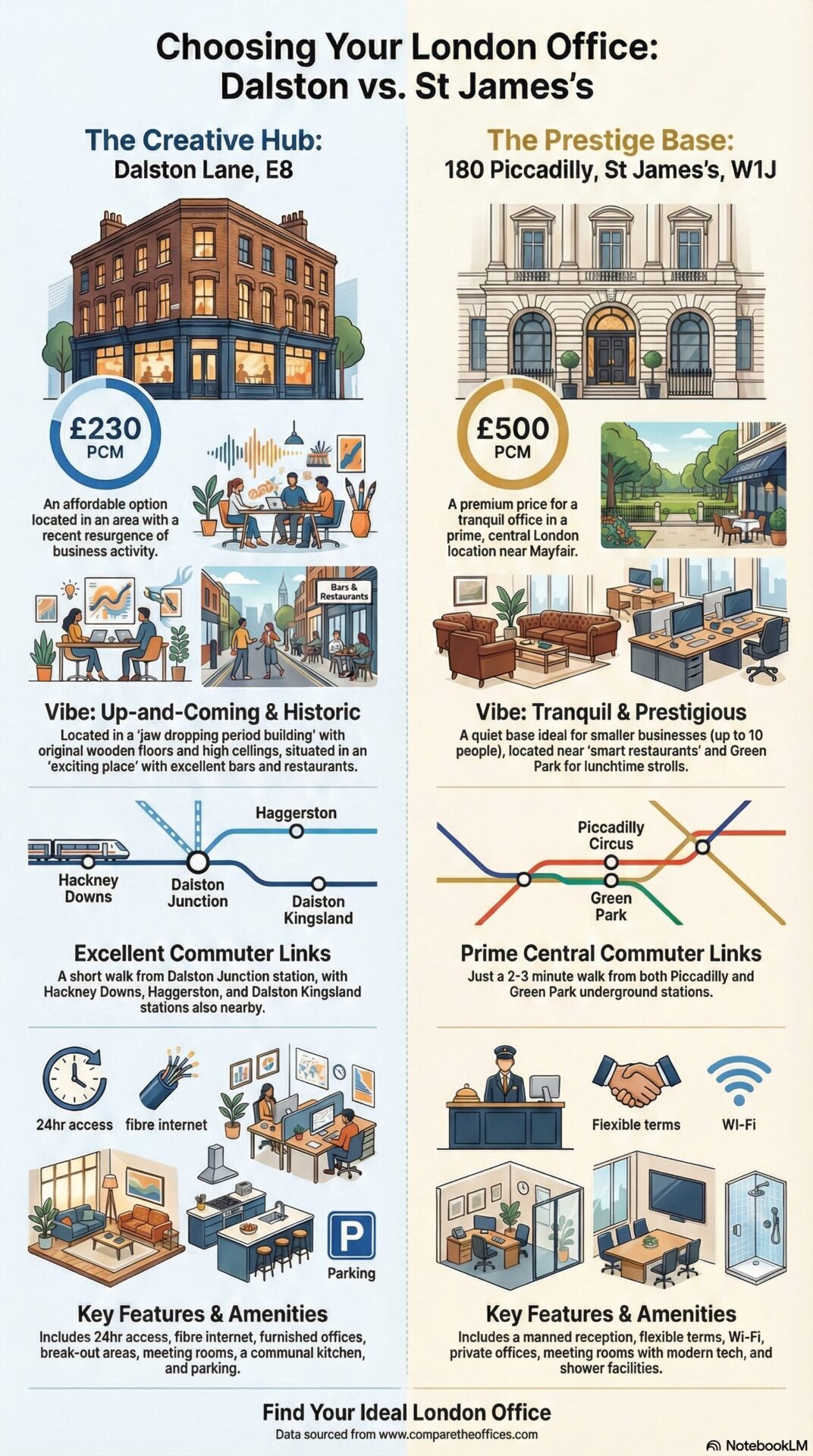
Finding the right Office Space London is about so much more than filtering by postcode. As our two examples show, the “vibe” and “ecosystem” of a workspace are hard business assets that directly impact talent retention and brand perception.
The perfect space is one that aligns not just with your headcount, but with your company’s culture. So, as you begin your search for flexible office space, look beyond the obvious. Instead of just asking where your business should be, start by asking who your business is.
Whether you need Dalston charm or Mayfair prestige, we have the perfect space.
Find My OfficeCosts vary wildly. Managed spaces in areas like Dalston can start from £230/desk, while premium serviced offices in Mayfair or St James’s average £500-£900/desk per month.
A serviced office is all-inclusive (rent, rates, utilities, furniture) with flexible terms. A traditional lease requires a long-term commitment and you manage all overheads yourself.
Yes, 99% of serviced offices in London come fully furnished with desks and chairs. Managed offices, however, may be unfurnished, so always check the listing.
For serviced offices, high-speed internet is standard. For managed spaces, it is often installed but you may need to set up your own contract or pay a connection fee.
Yes, especially in creative hubs like Dalston, Shoreditch, and Soho. Corporate buildings in the City or St James’s are less likely to allow pets due to building regulations.
Business rates are a tax on non-domestic property. In a serviced office, these are usually included in your monthly fee. In a traditional lease, you pay them directly to the council.
Contracts typically range from rolling monthly agreements to 12 months. This is far shorter than the 3-5 year minimums often found in traditional leases.
In “Serviced Offices London,” yes. You typically get mail handling and call answering. In “Managed” offices, this is rarely included.
Yes, most providers require a deposit, typically equivalent to 1-2 months’ rent, which is refundable at the end of your term.
It depends. Some providers offer a set number of free hours per month, while others charge a discounted hourly rate for tenants.