
The search to Rent an Office London often begins with a set of deeply ingrained assumptions. Business leaders typically brace themselves for a journey defined by prohibitive costs, iron-clad ten-year leases, and the immense capital expenditure required for a fit-out. The prevailing wisdom suggests a stark choice: settle for a bland, functional box in a secondary location, or commit a significant portion of future revenue to secure a prestigious postcode.
However, I have found that this perception is a relic of a bygone era. The modern commercial property market, particularly in the realm of Flexible office space London, has undergone a radical transformation.
Today, finding the right Office Space London is no longer about planting a flag at a set of map coordinates. It’s about discovering a strategic partner—a physical environment meticulously designed to catalyse growth, embody company culture, and eliminate operational friction. The decision extends far beyond the desk and chair; it is an investment in a fully-serviced ecosystem.
This article will dismantle the outdated myths by revealing eight surprising truths about the London office market. These insights will reshape your search, transforming it from a logistical headache into one of the most powerful strategic decisions your business can make.
A common and costly misconception is that an office rental provides four walls and little else. The reality of today’s market is profoundly different. A modern Serviced Office London delivers a comprehensive, pre-built support system engineered to absorb operational burdens.
Consider the specifics: a prime location in Piccadilly provides a fully staffed reception, where the team is on hand to provide administrative support as required. This instantly projects a polished, professional image without the significant ongoing cost of hiring front-of-house staff. By bundling reception, administration, and IT infrastructure, today’s serviced offices function as a complete business ecosystem.
The ‘vibe’ of an Office Space London is a critical strategic element. One can see a stark contrast in two exemplary central London offerings. The first, located in Euston Square, is a “stunning creative style” space featuring expansive floor-to-ceiling windows that flood the workspace with “ample natural light.” It radiates a dynamic, high-energy atmosphere.
In deliberate contrast, the One Eighty Offices in Piccadilly present a “tranquil central London office base” on a quiet street. This vibe is perfectly suited to a boutique consultancy where discretion is paramount. The right office is the one whose atmosphere aligns with your brand’s values.
The prestige of a globally recognised postcode like St James’s (W1J) has traditionally been assumed to have an insurmountable price tag. However, the serviced office model has democratised access. By shifting from high upfront CapEx to predictable OpEx, these spaces make a premium address a viable strategic asset.
For example, a sought-after address in Piccadilly is available from £500 PCM. These monthly fees encompass business rates, service charges, utilities, cleaning, security, and IT infrastructure. The all-inclusive nature makes a world-class address a financially astute choice.
In an era of volatility, agility is a prerequisite for survival. The traditional ten-year commercial lease is an operational straitjacket. Recognising this, the flexible office space market has hardwired flexibility into its core offering.
“Flexible Terms” allow a company to seize a new opportunity by quickly adding headcount or to navigate a downturn by consolidating its footprint without facing crippling financial penalties. This operational elasticity is a powerful tool for risk management.
Progressive workspaces are active instruments engineered to enhance human performance. The Euston office provides “Private Phone Booths” for deep concentration, while the Piccadilly location ensures business-critical functions run without friction via “fast secure internet.”
Simultaneously, both locations provide “Showers” and “Bike Storage,” encouraging healthy activities. The Euston property leverages “floor to ceiling windows” for natural light, while Piccadilly capitalises on its proximity to Green Park for lunchtime strolls.
One of the most surprising truths is the sophisticated integration of co-working spaces within premium serviced office buildings. The Euston Square property features not only private offices but also a “huge Coworking space London.”
This intelligent design allows a company to secure its own dedicated office while granting its team access to a much larger, collaborative ecosystem. It fosters a sense of community and creates organic opportunities for the cross-pollination of ideas.
The strategic value of an office is linked to its surrounding neighbourhood. The Euston Square office’s advantage is its connectivity, being “situated next door Euston Station.” In contrast, the Piccadilly office’s value lies in its proximity to “smart restaurants” for client entertainment. A truly strategic office search involves a rigorous analysis of the surrounding environment.
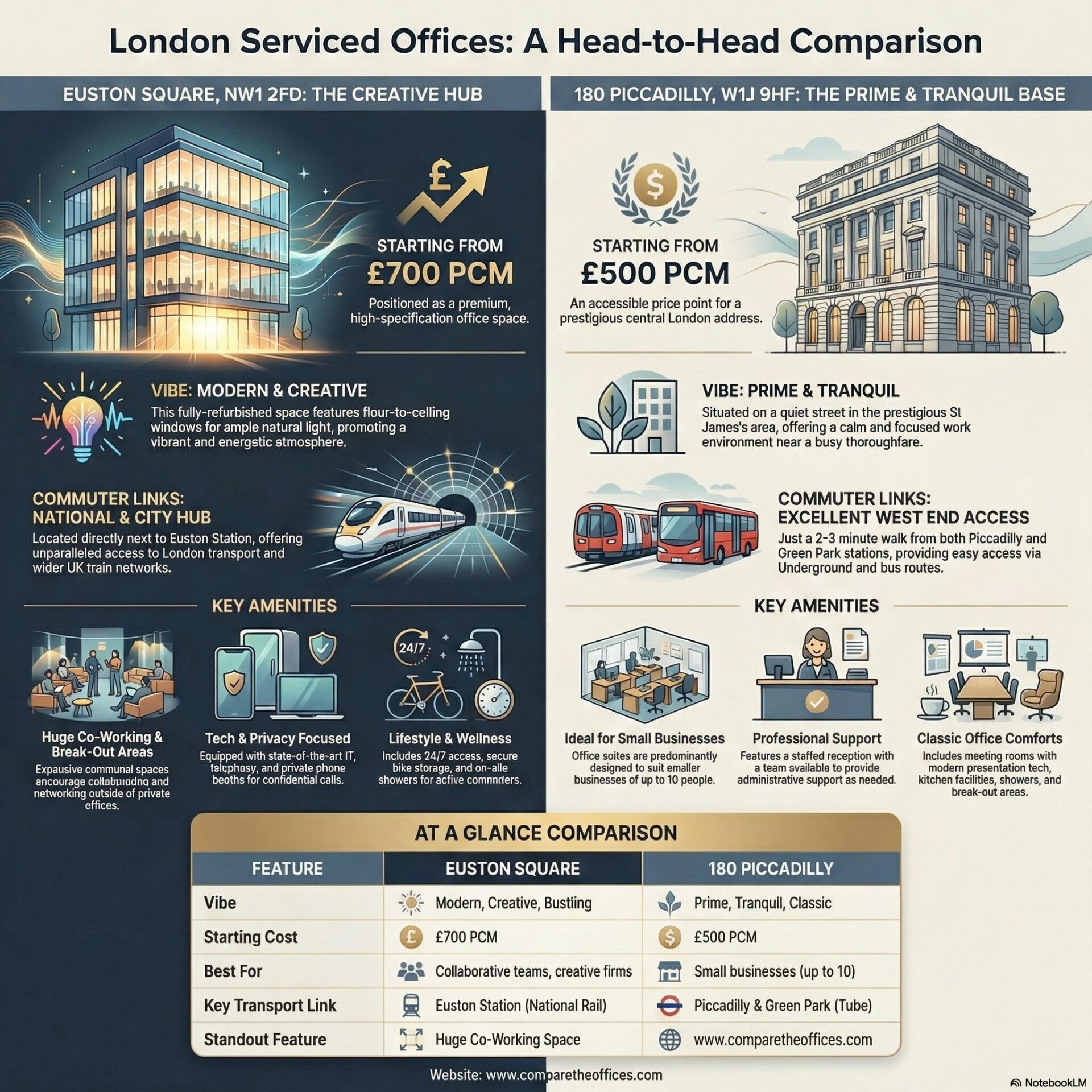
Modern serviced offices are adept at empowering smaller teams. The One Eighty Offices in Piccadilly exemplify this, offering suites designed “predominantly to suit smaller businesses of up to 10 people.” This offers prestige without excess.
In contrast, the Euston property demonstrates a different kind of scalability. A company can secure a modest private office but leverage the vast shared facilities as a flexible footprint. This versatility is key to the Office Space London market.
Choosing an office in London today is an exercise in strategic business alignment. As we have explored, the search must extend far beyond the postcode to engage with the very essence of your company’s culture. The modern workspace is a dynamic ecosystem offering integrated support services, curated atmospheres, and fundamental flexibility.
The most critical takeaway is this: the right office is no longer just a cost centre; it is a partner in your success. Therefore, the critical question isn’t just ‘Where should our office be?’ but ‘How can our workspace become a strategic asset that actively drives our business forward?’
Typically, one monthly fee covers rent, business rates, service charges, utilities, cleaning, reception services, furniture, and IT infrastructure.
Extremely. Most providers offer rolling monthly contracts or 12-month terms, allowing you to scale up or down with short notice.
While the monthly rent appears higher, serviced offices often work out cheaper overall because there is no CapEx for fit-outs, no dilapidation costs, and no hidden maintenance fees.
Yes, many providers allow branding within your private suite. However, public areas usually retain the provider’s branding to maintain a neutral, professional atmosphere.
Yes, all serviced offices have meeting rooms. Some include a credit allowance in your rent, while others charge a discounted hourly rate.
Yes, most London serviced offices use enterprise-grade dedicated fibre lines with backup redundancy to ensure 99.9% uptime.
Transparency is key in this sector. Extra costs are usually limited to consumables (coffee/tea), printing, and meeting room overage.
Absolutely. Many providers offer “Managed Floors” or “Enterprise Solutions” specifically for larger teams requiring privacy and customisation.
Agreements are much simpler than traditional leases (often just a few pages), so legal fees are significantly lower or unnecessary.
Yes, the vast majority of serviced offices in London offer 24/7 secure access via keycards or fobs.