
Finding the perfect Office Space London has become one of the most complex strategic challenges facing modern businesses. The days of simply filtering by postcode and price per square foot are long gone.
Today’s decision-makers are confronted with a dizzying array of options, from traditional leases to Flexible office space London, each carrying profound implications. The core truth is this: your office is no longer just a physical location for your team to work; it is a powerful statement of your company’s culture, a catalyst for its growth, and a cornerstone of its identity.
This choice is a strategic fork in the road. Will you opt for a prestigious address that communicates stability, or a dynamic hub designed for collaboration? This article delves beneath the surface, using two distinct London offices as a case study to reveal the surprising truths that can make or break your workspace decision.
By comparing two very different London office spaces—One Eighty Offices in Piccadilly and Upper Ground in Southwark—we can uncover the essential questions every business leader should be asking.
The intangible “vibe” of an office is a critical factor. The Piccadilly office is a “tranquil central London office base” on a “quiet street,” ideal for finance or law firms valuing discretion. In contrast, the Southwark office fosters a “community filled with… innovators,” built for energy and creative collision.
The choice between these two isn’t about which is better; it’s about which one is an authentic extension of your business’s soul. One promotes quiet excellence, while the other champions open innovation.
At first glance, the Piccadilly office (£500 PCM) seems more expensive than Southwark (£450 PCM). But the Piccadilly price includes “administrative support” and prestige, offering operational leverage.
Conversely, the Southwark office offers value through “networking events” and community infrastructure. The “best value” is subjective: are you paying for admin support or networking opportunities?
The Piccadilly office exemplifies the classic Serviced Offices London model: private suites, turnkey solutions, and professional support. This is ideal for established businesses needing privacy.
The Southwark property embodies the Coworking space London model, emphasizing community, shared break-out areas, and interaction. This is perfect for startups benefiting from the network effect.
Amenities are clues to work style. Piccadilly’s “manned reception” and high-tech meeting rooms suggest a client-centric, high-performance culture. Southwark’s “stocked kitchens,” “front desk services,” and “Phone Booths” signal a collaborative, agile tech culture.
The surrounding neighbourhood is integral. Piccadilly offers “smart restaurants” for high-stakes deal-making and Green Park for wellness. Southwark leverages the “South Bank” creative hub, offering inspiration and attracting talent who want a dynamic lifestyle.
One Eighty Offices taps into the Piccadilly line, connecting West and North London. Southwark, near “Waterloo and London Bridge,” opens up commuter routes from Surrey and Kent. When evaluating an office, you are mapping out your future workforce.
Piccadilly offers general “Flexible Terms,” implying negotiation within a traditional framework. Southwark explicitly offers “Monthly Contracts,” the hallmark of modern flexibility. Always ask: “What does flexible mean for my costs?”
Piccadilly targets “smaller businesses of up to 10 people,” offering intimacy and stability. Southwark targets “forward-thinking companies,” implying a scalable environment where you can grow from a single desk to a private suite.
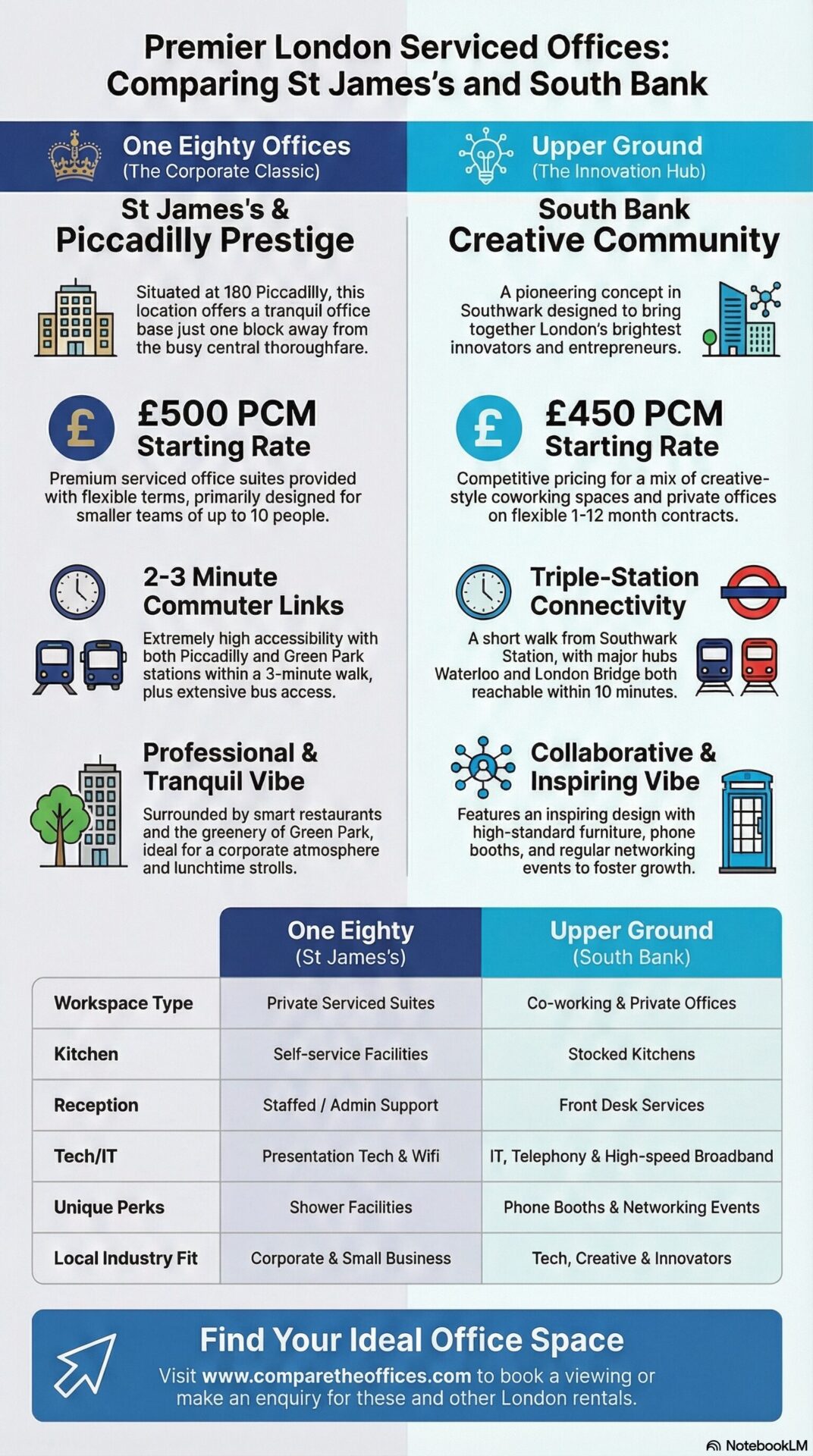
Ultimately, the search for a London office is a critical exercise in business strategy. The choice between a tranquil, serviced office in St James’s and a vibrant hub on the South Bank is an act of brand building.
Each element—from the amenities inside to the neighbourhood outside—must align with your vision. The next time you search for an office, will you be looking for square footage, or will you be looking for a strategic partner in your company’s future?
Office space typically refers to private, enclosed suites for your team, whereas coworking involves shared workspaces, hot desks, and communal areas for collaboration.
Prices vary by zone. In 2026, creative hubs like Southwark average £450/desk per month, while premium areas like St James’s average £500-£900/desk.
Yes, serviced office fees are all-inclusive, covering rent, business rates, service charges, utilities, and furniture.
Terms are very flexible, often starting from 1-month rolling contracts up to 12 months, unlike the 3-5 year commitments of traditional leases.
Many premium serviced offices include a staffed reception that handles mail, answers calls, and provides general admin assistance.
Reputable serviced offices provide dedicated fibre lines with redundancy to ensure high-speed, secure, and reliable internet access.
Yes, scalability is a key benefit. You can easily add more desks or move to a larger suite within the same building as your team grows.
Policies vary. Some providers give a monthly credit allowance, while others charge a discounted hourly rate for meeting room usage.
Yes, most serviced offices offer 24/7 secure access via keycards, allowing you to work according to your own schedule.
Many coworking-style spaces (like Southwark) offer free tea, coffee, and sometimes beer/snacks. Traditional serviced offices usually provide kitchen facilities but consumables may be extra.