
Finding the right Office Space London for your business can be an overwhelming challenge. The market is saturated with listings, and comparing options often feels like an exercise in weighing up apples and oranges. You might find two offices with nearly identical monthly costs, leading you to believe they offer similar value. But what if the real story is hidden in the details?
Imagine two flexible office spaces: one in Aldgate for £525 per month and another in St James’s for £500 per month. A mere £25 separates them, yet they offer vastly different experiences, amenities, and strategic advantages for a growing business. The monthly price tag is only the beginning of the story. As a commercial property journalist, I’ve found that the devil—and the value—is always in the detail.
This article dives deep into the surprising differences between these two seemingly comparable offices. I will explore nine critical truths that reveal what really matters when you decide to rent an office in London, proving that the most valuable choice isn’t always the one with the lowest price.
1. Location Isn’t Just an Address, It’s an Atmosphere
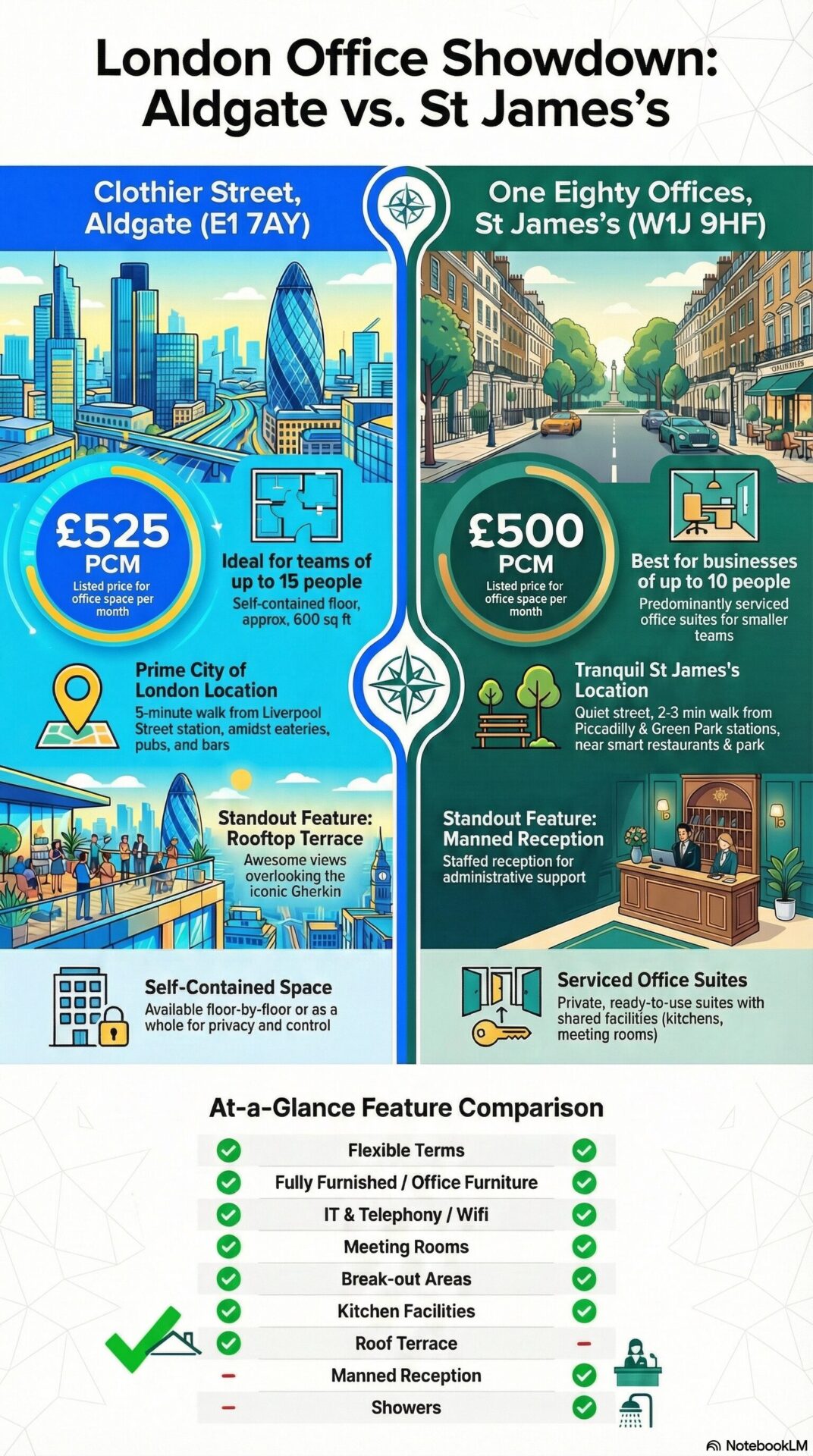
The postal code only tells part of the story; the immediate surroundings define the daily experience for your team and clients. The Aldgate office has a Prime City of London location, surrounded by a “vast array of eateries, pubs and bars.” This environment is ideal for a fast-paced company that thrives on the energy of the City, offering endless opportunities for after-work team bonding and informal client entertainment crucial for sales-driven or high-energy cultures.
In contrast, the St James’s office offers a “tranquil central London office base.” Located on a “quiet street just a block away from a busy thoroughfare” and near the prestige of Mayfair, it suits a business that values focus, a distinguished atmosphere, and proximity to the West End’s smart restaurants. The choice is between the vibrant hum of the financial district and the sophisticated calm of St James’s.
2. The Price is Identical, The Value is Not
The direct price comparison is £525 PCM for the Aldgate space and £500 PCM for the St James’s location. For a negligible difference, a business can select a package that is fundamentally different in its core offering. While both provide the baseline amenities expected today—including meeting rooms, break-out areas, and kitchen facilities—their unique features reveal their true value.
Monthly Price Comparison (Per Desk)
The Aldgate price includes access to a roof terrace and the option of self-contained floors, appealing to companies seeking privacy and impressive amenities. The St James’s price includes a staffed reception with administrative support and on-site showers, perfect for businesses that require a high-touch service model. This distinction is central to understanding the value proposition of Serviced Offices London.
3. Your “Break-Out Area” Could Be a Private Terrace or a Royal Park
Both properties offer break-out areas, but their nature could not be more different. The Aldgate property boasts a private and “awesome roof terrace overlooking The Gherkin,” an exclusive and impressive space perfect for company events, informal meetings, or entertaining clients.
The St James’s property leverages its location, with nearby Green Park serving as a world-class amenity. The park is presented as an “ideal place for a lunchtime stroll or to go jogging.” One offers an exclusive, built-in social hub; the other provides access to public green space that promotes employee wellbeing and a healthy work-life balance.
4. The Office Structure Dictates Your Company’s Growth
The physical layout of an office directly impacts how your company can scale. The Aldgate office provides “self-contained floors” of “circa. 600sqf,” each accommodating up to 15 people. A business can rent space floor-by-floor or lease the entire 5-storey building, offering a clear path to scale within the same address and preserve a unified company culture as you grow.
Conversely, the St James’s office offers suites “predominantly to suit smaller businesses of up to 10 people.” This structure is ideal for startups or small teams that value a professional community but may need to relocate entirely once they outgrow the space. One model is built for scaling in place; the other is tailored for intimate team environments.
5. “Serviced” Means Different Things: Autonomy vs. Support
The term “serviced office” can mean different things. The Aldgate space is described as “self-contained,” which implies a greater degree of autonomy for the teams occupying each floor. They manage their own environment within their dedicated space.
The St James’s property offers a more traditional serviced model, explicitly featuring a “staffed reception” with a team that is “on hand to provide administrative support as required.” This is a critical distinction. Consider your operational overhead: does your business have the resources for self-management, or would the cost of a full-time receptionist and admin far exceed the premium for a fully supported space? When comparing serviced office costs, factor in the hidden payroll savings.
6. Amenities Aren’t Just Perks, They’re Productivity Tools
On-site facilities can directly impact employee productivity and satisfaction. The St James’s office provides showers, a key feature for employees who cycle to work or exercise during lunch, directly complementing its proximity to Green Park. It also features a “self-service kitchen,” empowering staff with flexibility.
“The Aldgate office is structured more like a self-sufficient campus, highlighted by its most impressive feature: the awesome roof terrace overlooking The Gherkin.”
7. The Building Itself Can Be Your Brand
The structure of the property can become an extension of your company’s brand identity. At the Aldgate location, a company has the option to rent the entire “5 storey building.” This allows a business to effectively establish its own branded headquarters in the heart of the City, a powerful statement of presence and permanence.
The St James’s location provides “serviced office suites” within a larger property. This model offers the prestige of a W1J address and a professional base of operations without the overhead and responsibility of managing an entire building.
8. Connectivity is More Than Just WiFi
While both offices offer internet, the descriptions hint at different priorities. The Aldgate listing mentions a comprehensive “IT & Telephony” package, suggesting an all-in-one solution designed for seamless business operations.
The St James’s office highlights “fast secure internet” and meeting rooms equipped with “the latest presentation technology.” This may appeal more specifically to tech-savvy small businesses, consultants, or client-facing firms that rely heavily on high-quality digital presentations and secure connections. In the world of flexible office space, reliable tech is the bedrock of productivity.
9. Furnishings and Flexibility are the New Standard
Amidst all these differences, there is a common ground that defines modern flexible office space in London. Both properties offer “Flexible Terms” and come either “Fully furnished” or with “Office furniture.” This has become the baseline expectation in today’s market, allowing businesses to move in and become operational almost immediately, avoiding significant capital expenditure on fit-outs and furniture.
Conclusion: Look Beyond the Price Tag
When you rent an office in London, the monthly price is only the first line item on a much more complex balance sheet. As the £25 difference between the Aldgate and St James’s offices demonstrates, the real value is found by looking deeper. It lies in the details of the location’s atmosphere, the specific service model, the scalability of the space, and the amenities that will shape your company culture and support your strategic goals.
The right choice depends entirely on your business’s unique identity, needs, and vision for the future. The crucial question isn’t what you’re paying, but what you’re investing in: a simple address, or a strategic environment.
Frequently Asked Questions About Renting Office Space in London
1. Does a “self-contained” office mean I manage everything?
Not entirely. In a serviced building, utilities and basic maintenance are covered, but you have more control over the internal environment and culture than in a shared coworking space.
2. Are roof terraces common in London offices?
They are a premium feature, often found in modern City or Shoreditch developments. Finding one included in a £500-range office like the Aldgate example is exceptional value.
3. Can I get administrative support in any serviced office?
No. While most have a reception to greet guests, full admin support (mail handling, call answering) is a specific service offered by select providers like the St James’s location.
4. What is the typical notice period for these offices?
Flexible terms usually mean 1 to 3 months’ notice, though some providers offer rolling monthly contracts for maximum agility.
5. Is IT and Telephony always included?
It varies. Some “all-inclusive” rates cover it, while others charge a setup fee per desk. Always clarify this before signing.
6. Are meeting rooms free to use?
You typically get a monthly credit allocation. The Aldgate office’s “dedicated floor of meeting rooms” suggests high availability, a key asset for client-facing firms.
7. Can I rent an entire floor?
Yes, many providers offer whole floors as “Managed Offices,” allowing you to have your own front door and branding while retaining the flexibility of a serviced contract.
8. Is 24/7 access standard?
Most modern serviced offices offer 24/7 access via keycard, but it’s essential to check, especially in older heritage buildings where security might be restrictive.