
The great post-pandemic “return to office” debate is over, and a new, more strategic era of location choice has begun. As we look towards 2026, the obsession with a “prestige postcode” is fading, replaced by an intelligent focus on value, character, and connectivity.
For London’s founders, CFOs, and operations managers, this represents a pivotal opportunity to secure an Office Space London that doesn’t just house a business, but actively helps it thrive. I have spent the last few months speaking with asset managers, landlords, and occupiers across the capital to bring you a data-backed roadmap. This guide navigates the new landscape, ensuring your next move is your best move.
1. The Great Recalibration: Key Market Forces
Before beginning any office search, it is crucial to understand the fundamental market shifts that will define 2026. This is a pivotal year where regulatory changes and evolving work cultures are converging to create a “two-speed” market, rewarding businesses that plan ahead and penalising those that don’t. Understanding these forces is the first step towards making a truly strategic real estate decision.
The “Flight to Character”
The conversation has moved beyond generic “Grade A” glass boxes. The defining trend for 2026 is the “Flight to Character,” a widespread move by businesses towards authentic, sustainable, and inspiring spaces. Companies now recognise that the office itself is a critical tool for attracting and retaining top talent. This means seeking out beautifully converted warehouses in Hackney or unique buildings with a story, rather than simply defaulting to a famous but faceless address in Mayfair.
The “Value over Vanity” Mindset
For 2026, the definition of “value” has been recalibrated. It is no longer just about finding the cheapest rent. The new formula for value combines three key elements: affordable desk rates, outstanding transport connectivity, and a vibrant local community. Metrics like “Time-to-Meeting”—which measures how quickly your team can access key client and transport hubs—are replacing the simple prestige of a postcode. This strategic mindset is opening up new, dynamic parts of the city for ambitious businesses.
2. London Office Cost Benchmark: A Data-Driven Look at 2026
To make an informed decision, businesses need a clear, realistic benchmark of costs across London. The following data provides a snapshot of projected serviced office costs in 2026, comparing the city’s premium core locations with the high-value growth zones that are gaining momentum.
| District | Type | Avg Cost (per desk/mo) |
|---|---|---|
| Mayfair & St James’s | Premium Core | £950 – £1,500+ |
| City Core (EC2/EC3) | Premium Core | £650 – £900 |
| Farringdon | Creative Tech | £600 – £900 |
| Shoreditch | Creative Tech | £550 – £850 |
| Aldgate | City Fringe | £450 – £550 |
| Hackney | Value Play | £350 – £450 |
| Stratford | Value Play | £350 – £475 |
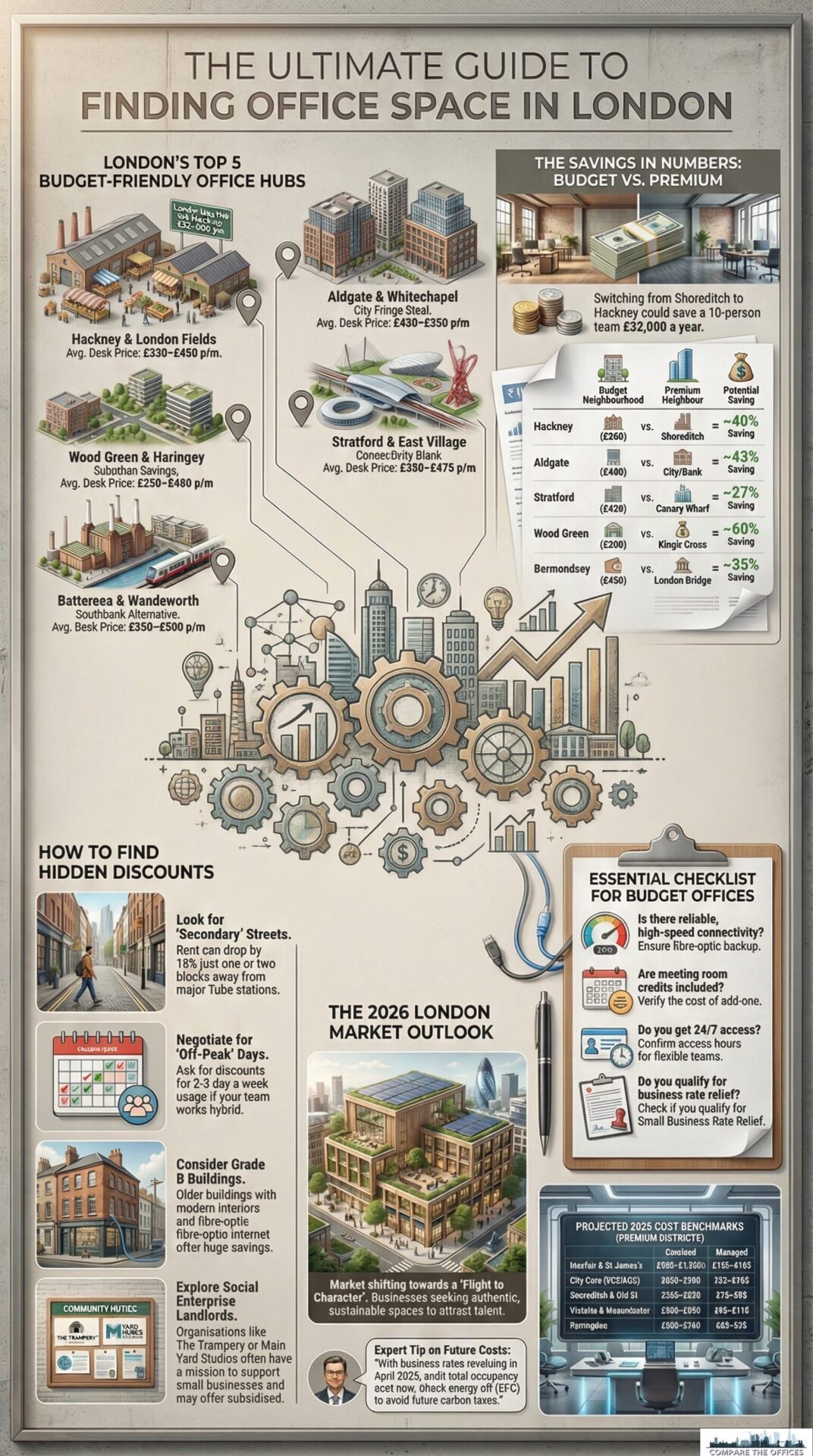
The financial impact of choosing a value-driven neighbourhood over a traditional one can be staggering. The savings unlocked can be reinvested directly into talent, technology, and growth. To put it in perspective: moving a team of 10 from a Shoreditch office to a characterful space in nearby Hackney could save you £32,000 a year.
Annual Savings: Shoreditch vs Hackney (10 Desks)
3. Neighbourhood Deep Dives: Finding Your Hub
Moving beyond raw data, let’s explore the unique character and business ecosystem of London’s key districts. The right neighbourhood is more than an address; it’s a strategic asset.
Aldgate & Whitechapel
The City Fringe Steal: A top pick for finance and tech startups seeking proximity to the City Core without the associated cost. The arrival of the Elizabeth Line at Whitechapel has been a game-changer.
Hackney & London Fields
The Creative Value Hub: Now the established home of London’s creative class, Hackney offers characterful and beautifully converted warehouses that appeal to young, tech-heavy teams.
Stratford & East Village
The Connectivity Giant: For businesses that need modern, Grade A specifications on a budget, Stratford is the answer. Unbeatable transport links via the Central, Jubilee, and Elizabeth lines.
Battersea & Wandsworth
The Southbank Alternative: The Northern Line extension has unlocked this South London hub. Look beyond the premium developments towards Wandsworth Town for riverside value.
4. Choosing Your Workspace Model
Selecting the right office model is as important as choosing the right location. The choice between a Serviced, Managed, or Leased space has profound implications for your company’s flexibility.
Serviced Office: This is the ideal solution for businesses that prioritise agility and speed. Offering all-inclusive pricing and flexible, short-term contracts, it is a “zero-CapEx” model that allows a company to move in and get to work immediately with no upfront fit-out costs.
Managed Office: The perfect middle ground, a managed office provides a bespoke, privately branded space without the long-term liability of a traditional lease. The provider handles the fit-out, facilities management, and billing.
Leased Office: The traditional choice for established teams of 50 or more people. A lease offers long-term stability and complete control over a custom fit-out.
5. The Savvy Renter’s Playbook
List prices are often just the starting point. Securing the best value requires an insider’s approach. Here are my expert tactics for finding hidden value.
“Expert Tip: With business rates revaluing in April 2026, audit your total occupancy cost now. Don’t just look at the rent—look at the energy efficiency (EPC) to avoid future carbon taxes.”
- Look for ‘Secondary’ Streets: Rent can drop significantly just one or two blocks away from a major transport hub. Walking an extra four minutes could save you 15%.
- Negotiate ‘Off-Peak’ Days: With hybrid work standard, ask serviced providers for discounts if your team only needs the office 2-3 days a week.
- Embrace Grade B Buildings: Many older buildings have modernised interiors and fibre-optic internet but lack the glass facade of a new build. These offer enormous savings.

Conclusion: An Expert’s Perspective
As London’s business map continues to expand, areas like Aldgate, Stratford, and Battersea now offer world-class connectivity and modern amenities at startup-friendly prices. Finding the perfect office is about making a smart, informed decision that supports your specific goals.
My final piece of advice is simple but critical: Use a map to plot your team’s commute before you sign. Often, a ‘cheaper’ office further out costs more in lost productivity if the journey is a nightmare. Choose the hub that works for your people, and you will find value that lasts.