
Searching for a Office Space London? You’re likely drowning in browser tabs, comparing postcodes and prices, and trying to decipher an endless list of features. Let me give you the insider’s view: you’re probably looking at the wrong numbers. The monthly price and the square footage are merely the headline acts in a far more complex and strategic performance.
The truth is that the perfect workspace is a critical business asset, one that should amplify your brand, attract elite talent, and eliminate operational friction. When you set out to Rent an Office London, you are not just leasing property; you are choosing the physical manifestation of your company’s culture and ambition.
This guide is designed to cut through the noise and give you the consultant’s perspective. We will move beyond the superficial price tag to uncover the eight surprising truths that truly define a valuable workspace. Using real-world examples, we’ll explore the subtle but powerful factors that will help you find a space that doesn’t just house your business, but actively helps it thrive.
1. Your Office Vibe is Your Brand’s Vibe
Before a client shakes your hand or a new hire logs on, your office has already made an introduction. Its location and style are a powerful, non-verbal statement about your company’s identity, making this choice a crucial branding decision. Consider it a key part of your talent acquisition stack.
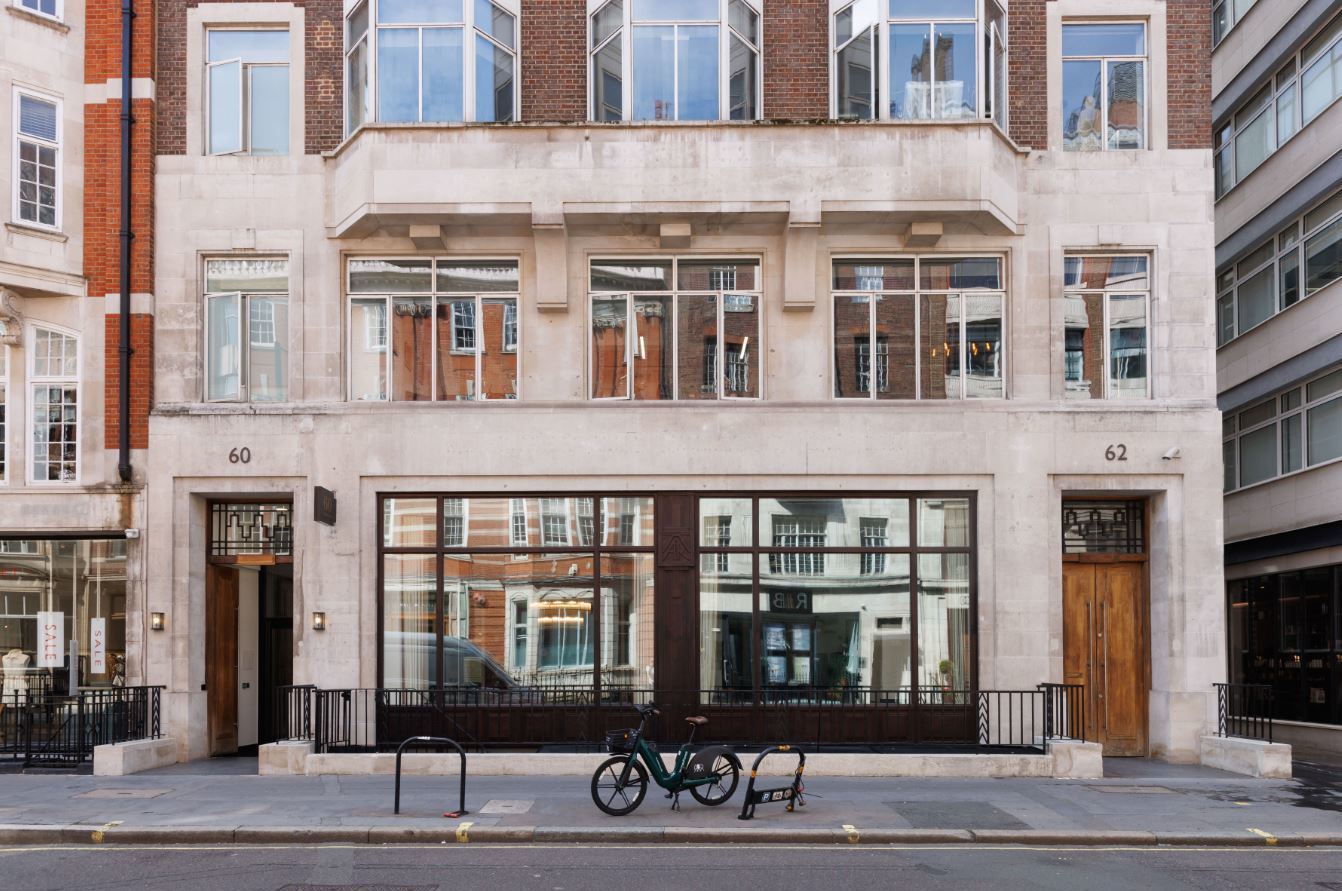
Imagine a tranquil base in a St James’s property on Piccadilly. Located on a “quiet street” but moments from “smart restaurants” and “Green Park,” it projects an aura of established prestige and quiet confidence. This environment is perfectly suited for a wealth management firm, a boutique consultancy, or a family office where discretion and a focused, corporate atmosphere are paramount. It signals stability and appeals to a certain profile of client and employee.
Now, contrast that with a space on St John’s Lane in Farringdon that “oozes character” and boasts “stunning original features.” Surrounded by a “vast array of pubs, bars and eateries,” this location communicates energy, creativity, and a dynamic culture. It’s the natural home for a tech start-up, a media agency, or a design studio looking to attract talent that values a vibrant social scene and a collaborative atmosphere. The question isn’t simply “where can we work?” but “which environment authentically reflects who we are and who we want to become?”
2. The Price Per Month is Only Half the Story
At first glance, comparing a £500 per calendar month office in St James’s to a £375 PCM option in Farringdon seems straightforward. But this simple calculation misses the most important part of the equation: the bundled value. Both operate on “all-inclusive, flexible terms,” and the real arbitrage is in understanding what that price actually buys you.
Price vs Service Level (Monthly)
The £125 monthly premium for the St James’s address isn’t just for the prestigious W1J postcode. It directly reflects the inclusion of a “staffed reception” with potential “administrative support”—a significant saving on what would be a full-time salary. This is a classic “serviced” office model, offering a comprehensive suite of amenities and support within a larger centre.
Conversely, the Farringdon property is listed as a “Managed Office.” While often used interchangeably, this can imply a more self-contained space with slightly fewer communal services, which is reflected in its more accessible price point. The value here is different; it has been “newly refurbished to a high specification,” meaning you avoid a five-figure capital expenditure on a fit-out. This all-inclusive approach is a defining feature of high-quality Serviced Offices London.
3. Amenities Aren’t Perks, They’re Essential Infrastructure
In the modern workplace, a well-curated set of amenities should not be seen as a collection of perks, but as the fundamental infrastructure required for productivity. These are the tools that enable your team to be effective from day one, eliminating the logistical headaches of setting up a new office. When assessing a space, look for precise, high-quality provisions.
| Amenity Focus | St James’s (W1J) | Farringdon (EC1M) |
|---|---|---|
| Connectivity | Fast Secure Wifi | Super-fast Fibre, Dedicated Line |
| Support | Manned Reception & Admin | Managed Infrastructure |
| Wellness | Showers & Green Park | Character Features & Light |
| Meeting Tech | Latest Presentation Tech | Standard Meeting Rooms |
The presence of this pre-installed infrastructure means your business bypasses weeks, or even months, of setup time. There is no delay waiting for an internet connection to be installed, no capital wasted on furniture, and no time lost coordinating suppliers. This plug-and-play reality is the bedrock of business agility, allowing your team to focus their energy entirely on core operations, not on office logistics.
4. True Flexibility Goes Beyond the Lease
The phrase “Flexible Terms” is often associated with short-term contracts, but its true strategic value lies in de-risking growth and enabling operational agility. A Flexible office space London is about far more than simply avoiding a five-year commitment; it’s about aligning your property costs directly with your business needs.
For example, the St James’s office is noted to suit “smaller businesses of up to 10 people,” allowing you to secure a footprint that matches your current headcount precisely, rather than paying for redundant space. To fully grasp the benefit, contrast this with a traditional lease. A conventional agreement locks you into years of liability and involves immense friction: months of legal negotiations, a significant capital expenditure on fit-out and furniture, and the looming financial risk of dilapidations at the end of the term. The flexible model eliminates these burdens.
5. Connectivity is Twofold: Digital and Physical
For any modern business, connectivity is the lifeblood of operations, and it must be assessed in two distinct, equally critical forms.
First, digital connectivity is non-negotiable. It’s not enough to simply have Wi-Fi; you need enterprise-grade infrastructure. The promise of “fast secure internet” is a given, but premier spaces offer “super-fast, fibre internet, with dedicated private and secure connection.” This ensures your team can operate at maximum efficiency, your data remains protected, and client video calls are seamless and professional.
Second, physical connectivity is paramount for attracting talent and serving clients. An office with poor transport links is a major liability. The St James’s location is a “2-3 min walk of both Piccadilly and Green Park stations,” placing the entire city within easy reach. Similarly, the Farringdon property is a “3 minute walk” from its station, with “easy access to Barbican and Chancery Lane.” This exceptional access via the Underground and bus routes makes the daily commute less stressful for your team.
6. The ‘Invisible’ Services Make the Biggest Difference
The most profound value offered by a serviced office often comes from the services you don’t see—the seamless, background operations that handle the complexities of workplace management. These elements are designed to mitigate operational drag, freeing up invaluable leadership time and mental energy. This is about buying back founder-focus.
Consider the “manned reception” at the St James’s property. This provides a professional, welcoming front door for your business, handles visitors, and manages deliveries without you needing to hire, train, and manage a receptionist. At the Farringdon office, the inclusion of “daily cleaning” ensures the environment remains pristine and productive every single day. These managed services are the hallmark of the Serviced Offices London model.
7. Your Surroundings are an Extension of Your Office
A great office doesn’t exist in a vacuum; its value is magnified by its local environment. The surrounding streets, parks, and establishments function as a crucial “third space”—an extension of your office that supports client entertainment, team well-being, and informal collaboration.
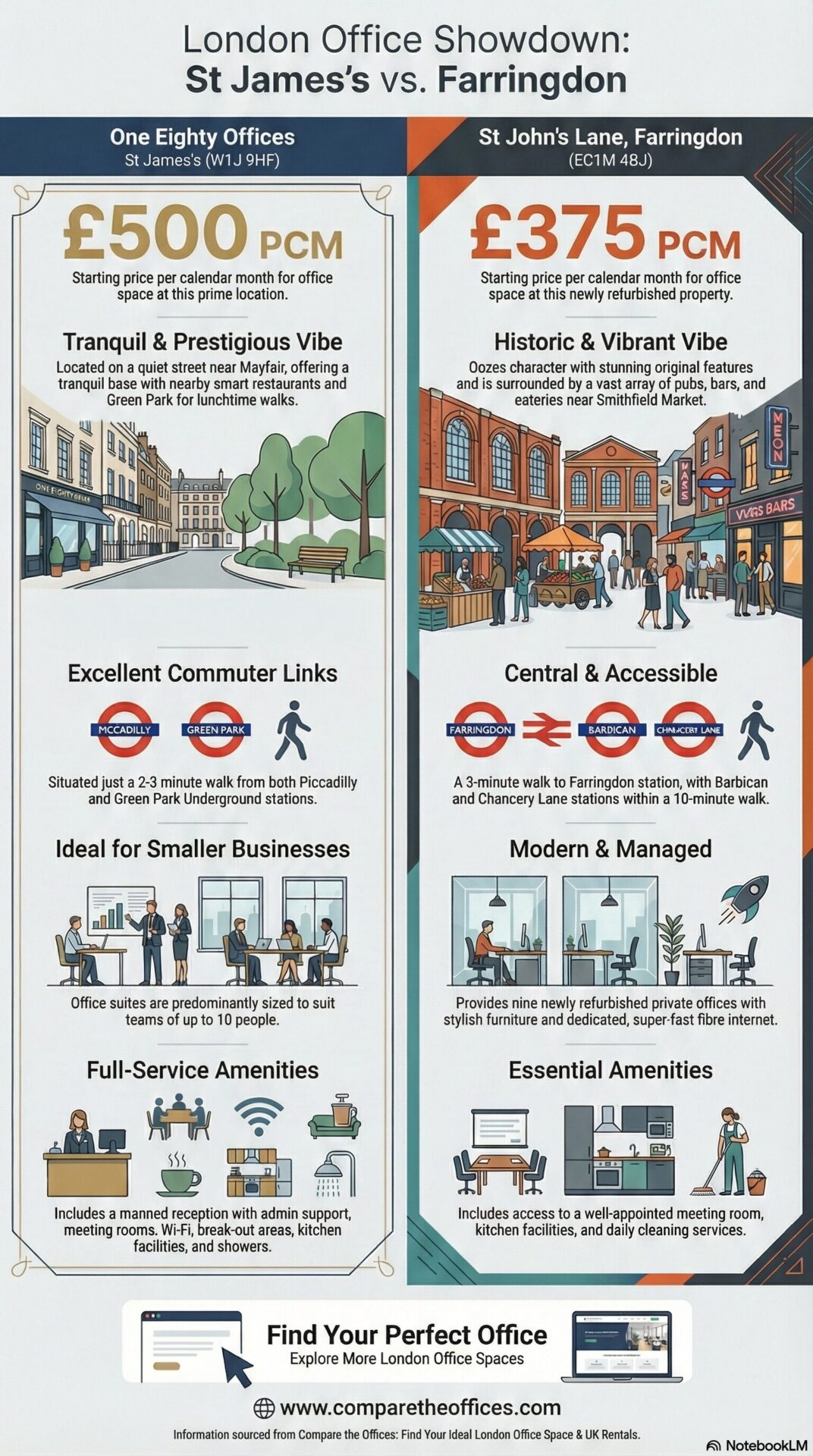
The St James’s location, with its proximity to “smart restaurants,” offers an impeccable setting for high-stakes client lunches. Meanwhile, “nearby Green Park” provides a vital outlet for employees to take “a lunchtime stroll or to go jogging,” supporting mental and physical health in a polished, corporate ecosystem. Contrast this with the Farringdon office, situated “a few moments away from Smithfield market” and “surrounded by a vast array of pubs, bars and eateries.” This buzzing environment is perfect for after-work team socials and casual coffee meetings.
8. Character and Modernity Can Coexist
A common misconception is that businesses must choose between an office with historic charm and one with modern, high-spec functionality. The reality is that the best workspaces offer a compelling fusion of both, creating an environment that is both inspiring and highly productive.
The Farringdon office is a perfect case study. It is described as being “Newly refurbished to a high specification,” ensuring it delivers the critical infrastructure a modern business demands. Yet, at the same time, the building “oozes character and enjoys a plethora of stunning original features.” This blend of old and new creates a workspace with a unique identity and soul, setting it apart from generic office blocks. It proves that you don’t have to sacrifice style for substance.
Conclusion: Finding Your Perfect Fit
The search for the right London office is ultimately an exercise in looking beyond the headline price to understand the complete value proposition. The perfect space is a strategic alignment of vibe, service, and location. As we’ve seen, the decision hinges on matching the office’s character to your brand, appreciating the true financial upside of all-inclusive services, and demanding excellence in both digital and physical connectivity.
The London market offers a spectacular range of options, from tranquil corporate bases in St James’s to dynamic, character-filled hubs in Farringdon. By considering the full picture—the bundled amenities, the local ecosystem, and the invisible services—you transform a real estate decision into a powerful investment in your company’s culture and future growth.
Frequently Asked Questions
1. What is the average cost of Office Space London in 2026?
Costs vary significantly by location and type. A prestigious serviced office in Mayfair or St James’s can range from £800-£1200+ per desk/month, while managed spaces in areas like Farringdon or Shoreditch may range from £450-£700 per desk/month. Remember to compare ‘all-inclusive’ value versus bare rent.
2. What is the difference between Serviced and Managed offices?
Serviced offices are ‘plug-and-play’ with all amenities (reception, cleaning, internet) included in one bill. Managed offices offer more autonomy and privacy—often a self-contained floor—but you may manage some services yourself, though the fit-out is usually provided.
3. Why should I choose flexible office space in London over a traditional lease?
Flexible space minimizes capital expenditure (CapEx) and liability. You avoid long lock-in periods, expensive fit-outs, and dilapidation costs. It allows you to scale up or down as your team size changes, providing agility in a fast-moving market.
4. How quickly can I move into a London office?
With serviced or managed offices, you can often move in within 24 to 48 hours. The infrastructure (internet, furniture, utilities) is already in place, unlike traditional leases which can take months to finalize.
5. Is a St James’s address worth the premium?
If your business relies on projecting stability, wealth, and prestige—such as hedge funds or family offices—the premium is often an investment in brand trust. The address signals success to prospective clients before they even meet you.
6. Does the monthly price include business rates?
In almost all serviced and flexible office agreements, the monthly fee is all-inclusive, covering business rates, service charges, utilities, and internet. Always check the contract details to be sure.
7. What ‘invisible services’ add value to an office?
These are the operational tasks handled by the provider: reception staffing, security, daily cleaning, mail handling, and IT maintenance. They save you the cost of hiring administrative staff and allow you to focus purely on your business.
8. Can I brand a serviced office space?
Yes, many providers now allow significant customization, especially in ‘managed’ suites. You can often add your logo to the door, paint walls, and configure the layout to reflect your company culture.