
The process to Rent an Office London can feel like an overwhelming expedition. The sheer volume of options, the labyrinth of pricing structures, and the pressure to find a space that not only fits the budget but also fuels the business can leave any decision-maker exhausted.
In recent years, I have found that the landscape has shifted dramatically. The rigid, long-term commitment of a traditional lease is giving way to a more agile approach, with flexible office space and serviced offices becoming the new standard for businesses of all sizes, from fledgling startups to established firms.
What truly defines the right workspace for your team? Is it simply the price per month or the prestige of the postcode? The answer, increasingly, lies in the subtle details that are often overlooked in a standard property search. The atmosphere, the type of community it fosters, and the specific amenities on offer can have a more profound impact on your company’s culture, productivity, and brand identity than the address alone.
By comparing two very different, real-world Office Space London examples, we can uncover the nuanced factors that separate a good office from a great one. This guide will reveal nine surprising truths to help you conduct a smarter search and find a workspace that is a true strategic asset.
The following insights are derived from a direct comparison of two available office spaces: a creative hub in Camden and a professional suite in St James’s. Their differences reveal what truly matters when choosing your next business home.
The ‘vibe’ of an office is more than a feeling; it’s a tangible asset that directly influences your company culture. Consider our first case study, a property on Chalk Farm Road in Camden. It boasts a “modern industrial look” and is “much favoured by startups,” projecting an image of innovation and creative grit.
In stark contrast, our second space in St James’s offers a “tranquil central London office base” on a “quiet street.” This creates an atmosphere of focus, discretion, and calm professionalism. When assessing an Office Space London, you must ask which atmosphere aligns with your corporate identity.
At first glance, the pricing seems simple: the Camden space is listed at £300 per calendar month, while the St James’s office is £500. A direct comparison, however, is misleading without a strategic analysis of what that cost delivers.
The Camden office’s price represents an investment in human capital, bundling in “exercise classes and networking events.” Conversely, the St James’s property’s price is an investment in operational leverage, including a “staffed reception” and “administrative support.” The best value is not the lowest price, but the package that represents the smartest strategic investment.
Invests in:
Community & Wellbeing
Invests in:
Support & Prestige
The modern office is no longer just a place for work. The Camden property exemplifies an integrated wellness strategy with on-site “showers” and “exercise classes.” The St James’s office leverages the surrounding cityscape, situated near “plenty of smart restaurants” and “Green Park.” Both add immense value by promoting employee well-being, a critical factor for talent retention.
The Camden space is explicitly engineered to foster interaction with “open walkways” and “co-working spaces.” It is a space built for teams who thrive on shared energy. The St James’s property, by contrast, prioritises privacy with “private offices” suited for “smaller businesses of up to 10 people.” Assess your team’s needs honestly: do you require an incubator for collaboration, or a sanctuary for concentration?
“Flexible Terms” is a headline feature for both properties, but meanings vary. For a startup-focused space like Camden, “flexible” likely refers to operational agility to scale space up or down. For a premium space like St James’s, “flexible” might relate more to service customisation. True due diligence requires asking providers to define exactly what “flexible” means.
The Serviced Offices London market is segmenting. The Camden office is “favoured by startups,” while the St James’s property targets “smaller businesses” like consultancies. Finding the right fit means finding a space that understands and is built for your business model.
Every business needs a support system. The Camden model prioritises robust, self-service infrastructure for tech-centric teams that value autonomy. The St James’s model invests in a high-touch experience with a “staffed reception.” The question is what removes the most operational friction for your team?
In London, details matter. The Camden office is “six minutes away” from the station. However, the St James’s office is a “2-3 min walk of both Piccadilly and Green Park stations.” In London’s fast-paced market, that three-minute difference is a tangible advantage.
Ultimately, your office is a powerful form of brand signalling. Choosing Camden signals an affiliation with startup culture and innovation. Opting for St James’s communicates establishment and professionalism. Your London workspace is not just a place of work; it’s a strategic branding tool.
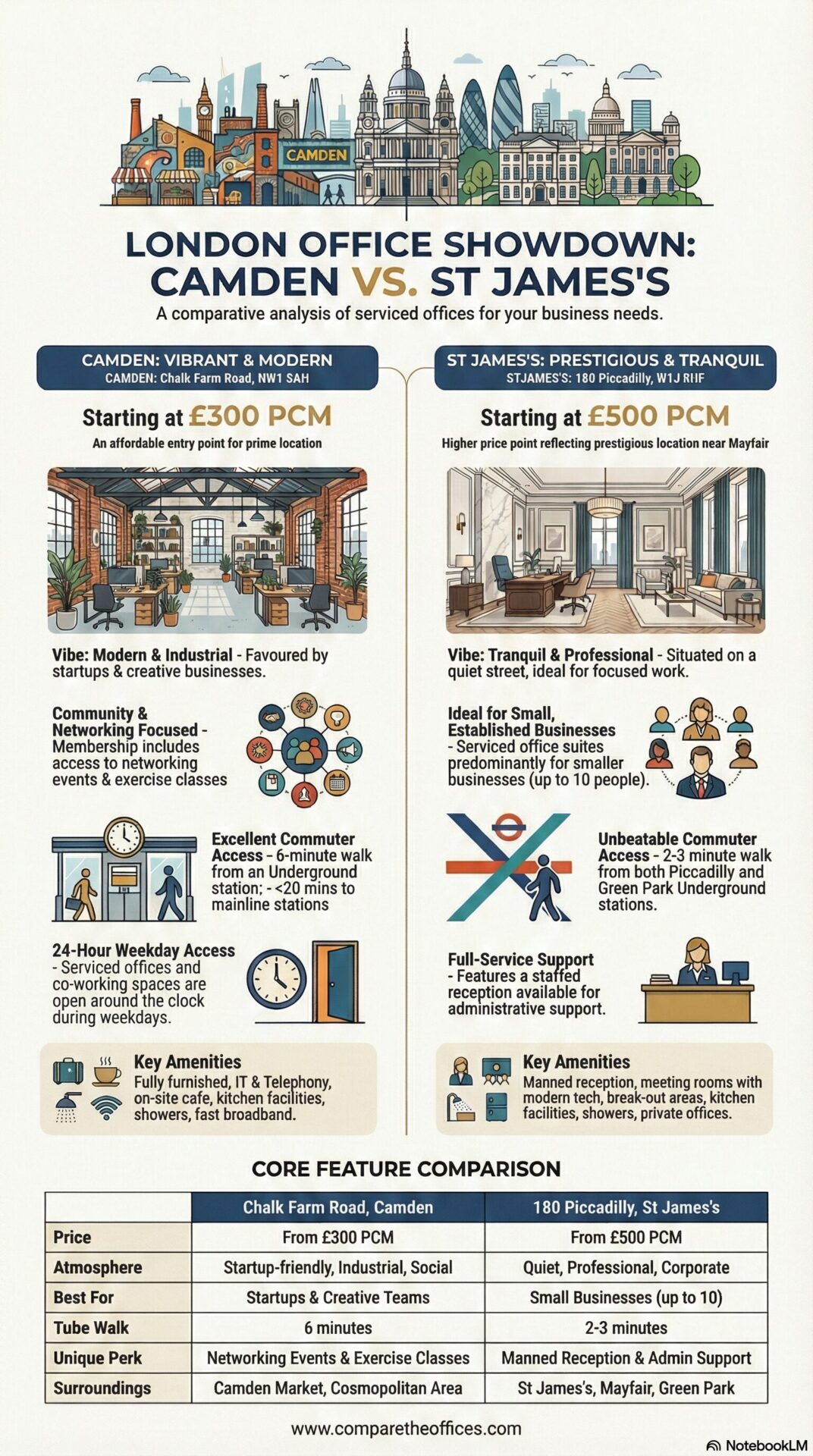
Choosing an Office Space London is one of the most significant strategic decisions a business can make. The right choice is rarely about simply finding the most affordable square footage; it is a nuanced decision that must account for the intangible assets a workspace provides.
The core choice often boils down to a fundamental strategic question: is your office an incubator of culture or a projector of prestige? By looking beyond the headline price and postcode, you can find a space that doesn’t just house your business, but actively helps it thrive. Instead of asking, “What office can we afford?”, ask, “Which office will get us to where we want to be?”
Serviced offices are fully furnished, all-inclusive workspaces with flexible terms. Traditional leases are long-term commitments where you manage all facilities and costs yourself.
In 2026, prices range from £300/desk per month in creative hubs like Camden to £500-£1,000/desk in premium areas like St James’s or Mayfair.
Yes, business rates are typically included in the single monthly fee of a serviced office, whereas they are an extra cost in traditional leases.
Yes, many creative and flexible office spaces (especially in areas like Shoreditch and Camden) are now pet-friendly.
Policies vary. Some providers include a monthly credit for meeting rooms, while others charge a discounted hourly rate for tenants.
Most reputable providers offer enterprise-grade fibre internet with backup lines to ensure 99.9% uptime and high speeds.
Contracts are highly flexible, ranging from rolling monthly agreements to 12-month terms, allowing you to scale easily.
Yes, most providers require a deposit, usually equivalent to 1-2 months’ rent, which is refundable at the end of the term.
In private suites, branding is often allowed. However, communal areas usually remain neutral to maintain a professional standard for all tenants.
Yes, most serviced offices include a staffed reception to greet guests, handle mail, and provide administrative support.