
When searching for the perfect Office Space London, it’s easy to get tunnel vision. The search often narrows down to two key metrics: location and the monthly price tag. But as a commercial property journalist, I’ve seen too many businesses make the mistake of stopping there. What if two offices, with nearly identical costs, could offer fundamentally different futures for your business?
This isn’t a hypothetical; it’s the reality of London’s dynamic property market in 2026. Consider two options I recently analyzed: a characterful, newly refurbished, pet-friendly space in the vibrant heart of Shoreditch for £520 per month, and a tranquil, professional suite in prestigious St James’s for £500 per month. On paper, the cost difference is negligible—the price of a client lunch. But in reality, the choice is monumental.
This article unpacks the hidden factors and surprising truths that these two examples reveal about the market for Serviced Offices London. Our analysis uncovered eight critical factors that every business leader should consider before signing on the dotted line.
1. The Great Price Deception: Why Postcode Isn’t Everything
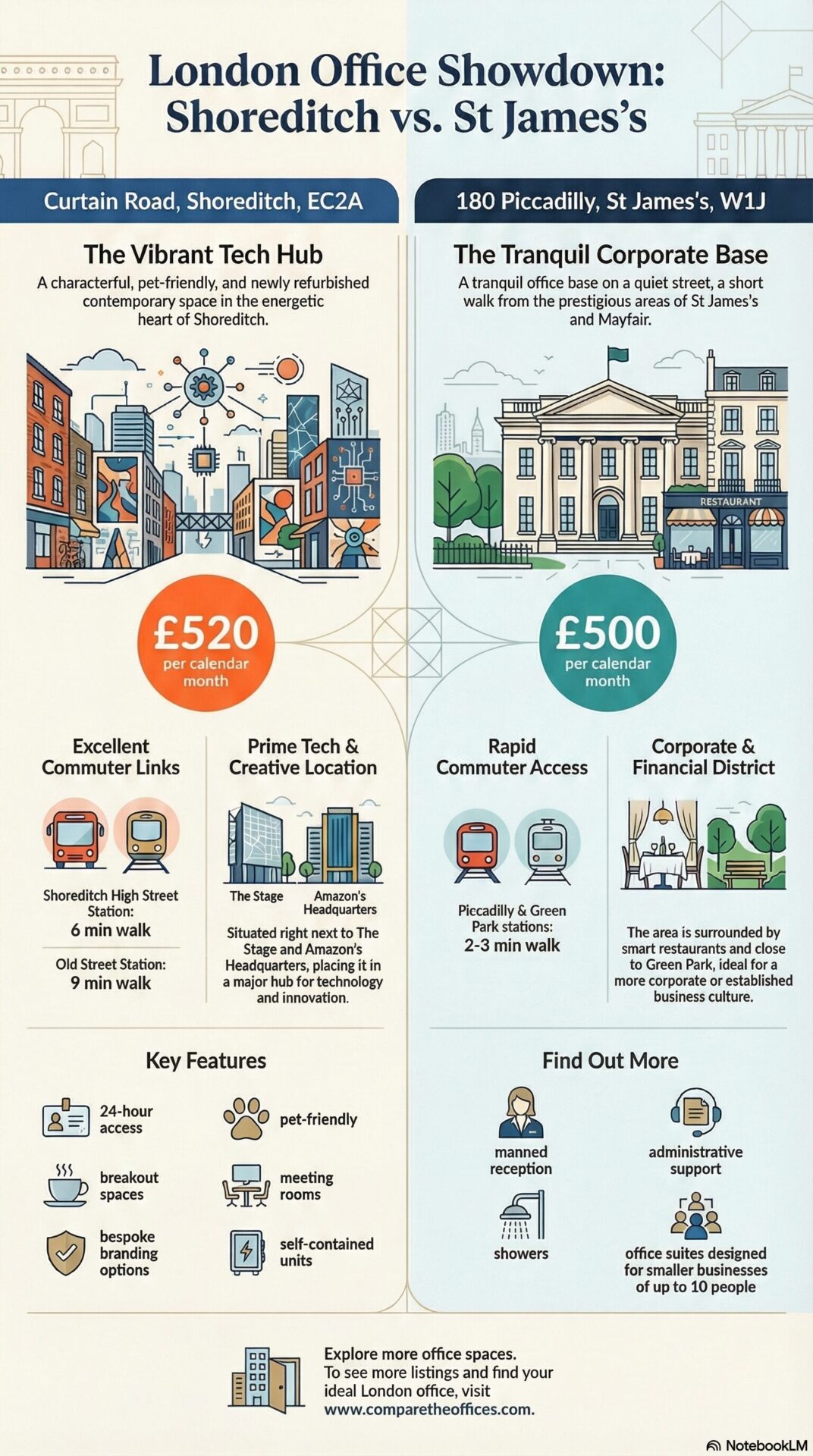
The most startling discovery is the near-identical pricing: £520 per month in Shoreditch versus £500 per month in St James’s. This directly challenges the conventional wisdom that a prestigious West End address will always be significantly more expensive than a hub in the East London tech cluster.
This reveals a crucial insight for any business looking to Rent an Office London: true value isn’t dictated by the postcode alone. The market has matured to a point where the specific building, its features, and the atmosphere it cultivates are just as important as the neighbourhood name on the letterhead. You are no longer paying for just a location; you are paying for an identity.
Cost Parity: East vs West
2. Your Office Vibe is Your Brand’s Bat-Signal
The “vibe” of an office is a powerful, non-verbal communication tool. Here, you are choosing between projecting disruptive innovation or established trust.
The Shoreditch space is described as “characterful,” “contemporary,” and located in the “vibrant heart of Shoreditch” next to Amazon’s Headquarters. This environment is a bat-signal for tech startups, creative agencies, and high-growth companies that want to project innovation and a connection to the digital zeitgeist. In stark contrast, the St James’s office offers a “tranquil central London office base” on a “quiet street.” This projects stability and discretion. It’s the ideal choice for financial consultancies, boutique law firms, or wealth managers whose brand is built on trust and tradition.
3. Amenities Aren’t Perks; They’re a Cultural Blueprint
The amenity stack is the most reliable indicator of a workspace’s target culture. The offerings here aren’t just conveniences; they are a clear blueprint for the type of company the space is designed to support.
The Shoreditch office’s features—being “pet-friendly” and offering “bespoke branding” within a “newly refurbished” space—point directly to a culture that values autonomy, creativity, and modern work-life integration. Conversely, the key amenities in St James’s—a “manned reception,” “administrative support,” and “fast secure internet”—signal a high-touch service environment. These features are designed for busy professionals who value efficiency and the convenience of having their daily needs met.
4. The Autonomy Index: “Self-Contained” vs. “Fully-Serviced”
Your choice is between total brand control and minimizing operational overhead. The Shoreditch property offers “private self-contained offices,” which provides a business with a higher degree of privacy, creating a mini-HQ within a larger building where a company can cultivate its unique culture in near-total isolation.
The St James’s location provides “serviced office suites,” a model that offers a more integrated experience. By providing a staffed reception and administrative support, it allows a company to outsource facilities management and reduce operational overhead. This distinction is the heart of the Flexible office space London trend.
5. The Ecosystem Effect: Who Are Your Neighbours?
The businesses and landmarks surrounding your office create a powerful ecosystem, acting as a centre of gravity for specific industries. The Shoreditch office is strategically placed “right next door to The Stage and Amazon’s Headquarters,” embedding a company directly within London’s primary tech cluster.
The St James’s office boasts proximity to “Mayfair” and “plenty of smart restaurants.” This places a business in the heart of London’s traditional commercial district, providing access to a network of established corporations and high-level decision-makers.
6. More Than a Desk: Your Team’s Lifestyle and Wellbeing
An office’s location is a core component of your employee value proposition. The St James’s office offers a distinct lifestyle benefit, noting that “Nearby Green Park makes an ideal place for a lunchtime stroll or to go jogging.” This appeals to individuals who value access to green space.
The Shoreditch location, by contrast, offers “an abundance of amenities within Shoreditch itself,” catering to a team that thrives on the energy of a vibrant, amenity-rich urban environment with endless options for food and socialising.
7. The Commute Calculation: Accessibility as a Strategic Tool
Public transport access is a strategic tool for tapping into London’s diverse talent pools. The Piccadilly line at Green Park offers a direct link to Heathrow, a non-negotiable for businesses with international clients. In contrast, Old Street’s Northern Line and Shoreditch’s Overground access are a direct artery for talent commuting from the vibrant residential hubs of North and East London.
8. Sizing Up for Success: Finding the Right Fit
Finally, the physical structure of the office space should match your team’s scale and ambition. The St James’s property is explicitly described as suiting “smaller businesses of up to 10 people.” This model is perfect for lean teams and startups that value a turnkey solution.
The “self-contained units” in Shoreditch imply a different model, catering to teams that require more distinct separation or a more modular way to scale. The best office isn’t just about total square footage; it’s about finding a space with a configuration that aligns with your team’s current structure.
Conclusion: What is Your Office Saying About You?
When looking for Office Space London, it’s clear that the choice is a strategic business decision that goes far beyond a simple calculation of cost and location. It is an investment in your brand, your culture, and your people. The physical space you inhabit is a constant signal to clients, partners, and potential hires about who you are and what you value.
If your office is the physical embodiment of your brand, what statement do you want to make? The choice between Shoreditch innovation and St James’s tradition is yours.
Frequently Asked Questions About Renting Office Space in London
1. Why are office prices in Shoreditch and St James’s so similar?
Prices are converging because demand for creative, amenity-rich spaces in East London has risen, while traditional West End landlords are pricing competitively to attract smaller businesses.
2. What does “self-contained” mean in an office listing?
It typically means you have your own private entrance, meeting rooms, and kitchen within your suite, rather than sharing these facilities with other tenants on the floor.
3. Are pet-friendly offices common in the West End?
They are less common in traditional areas like St James’s or Mayfair due to lease restrictions in heritage buildings. Shoreditch and Farringdon have a higher density of pet-friendly options.
4. Do serviced offices include administrative support?
Premium serviced offices, like the St James’s example, often include a reception team that can handle mail, answer calls, and greet guests as part of the package.
5. Is the monthly price really all-inclusive?
Generally, yes. It covers rent, rates, utilities, and furniture. However, always check for extras like high-volume printing, coffee, or IT setup fees.
6. What is the minimum term for these offices?
Flexibility is standard. You can find terms from 1 month to 3 years. 12 months is a common sweet spot for securing the best rate.
7. Can I brand my office space?
In “self-contained” or “managed” spaces (like the Shoreditch example), you often have significant freedom to brand the interior. In shared serviced buildings, branding is usually limited to your suite door.
8. Is 24/7 access standard?
Most modern offices offer 24/7 access via keycard, but it is essential to check, especially in older buildings where security might be restricted on weekends.