
Searching for a new office is often seen as a practical, if unexciting, task. Most leaders scan property listings with a narrow focus: price per square foot, location, and capacity. It’s a search for a container, a physical space to house operations. But what if these listings were more than just a collection of facts and figures? What if they were telling a deeper story about the evolution of work itself?
Finding the perfect Office Space London offers is about decoding the market. When you look closer, these seemingly straightforward documents reveal fascinating insights into shifting business priorities, emerging company cultures, and the new demands of the modern workforce. They are a real-time reflection of how businesses are adapting to a world where the purpose of the office is being fundamentally re-evaluated.
By analyzing just two serviced office listings in central London—one in upscale Mayfair and another in the financial hub of the City—we can decode how they reveal four critical shifts in corporate strategy, from financial agility to talent acquisition. Let’s explore what the data is really telling us.
1. The Prestige-Price Gap is Narrower Than You Think
There’s a common assumption that a world-renowned address comes with an impossibly premium price tag. You would expect an office in Mayfair, a postcode synonymous with luxury, to be drastically more expensive than a comparable space in the City of London. However, the listings data reveals a surprising convergence in pricing.
The boutique office on Green Street, Mayfair, is listed at £650 per desk per month. Meanwhile, the creative workspace at Dukes Place in Aldgate, in the heart of the City, is listed at £575. This represents a mere 13% premium for the Mayfair address, signaling a market disruption. Crucially, the Mayfair listing specifies it accommodates “businesses up to 25 staff.” This turns postcode prestige from a corporate luxury into a viable marketing tool for growth-stage companies.
Access to iconic addresses is now more attainable than ever, allowing smaller businesses to project an image of established success without the traditional capital commitment. When evaluating serviced office costs, the premium for prestige is surprisingly low.
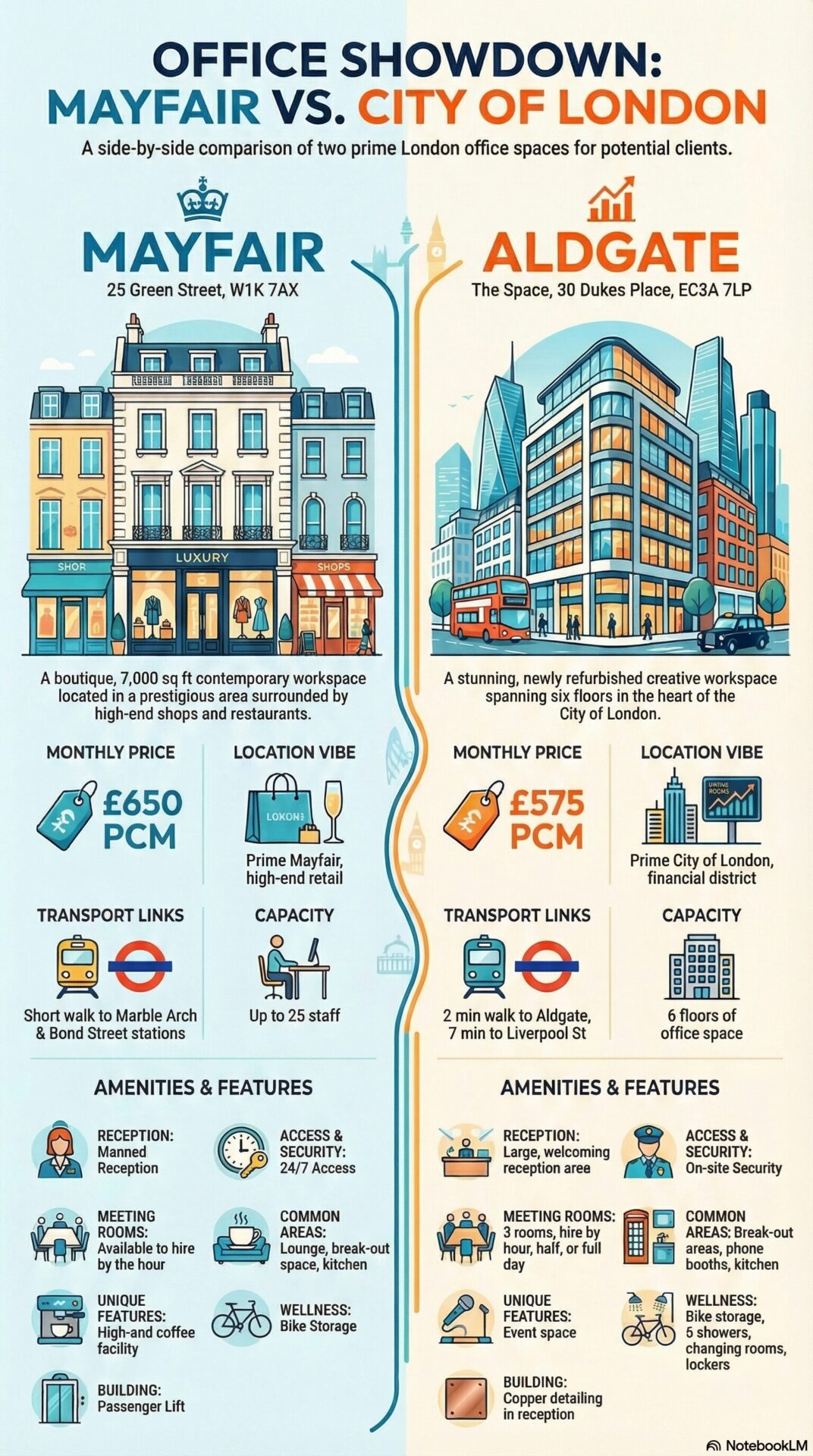
Price Comparison (Per Desk/Month)
2. Amenities Are a Window into Company Culture
An office’s list of amenities has moved far beyond simple practicalities. Today, this list is a curated statement about a company’s priorities and a direct investment in its business functions. The contrast between our two London listings is a perfect example.
The Mayfair office highlights a “manned reception” and a “lounge area with a high-end coffee facility.” These are investments in client acquisition and impression management, creating a formal, prestigious environment designed to host and impress. The reception is a gatekeeper. It speaks to a culture of exclusivity and high service standards.
In contrast, the Aldgate office boasts a “large and welcoming reception area, with copper detailing.” This is the language of a host, not a gatekeeper. Its other amenities—an “event space,” “phone booths,” and “6 showers with changing room facilities”—are clear investments in employee well-being, internal collaboration, and talent retention. One space is built for external prestige; the other is engineered for internal culture, supporting a dynamic, commuter-friendly, and highly collaborative workforce. The choice between them isn’t about facilities; it’s about philosophy.
“One space is built for external prestige; the other is engineered for internal culture. The choice between them isn’t about facilities; it’s about philosophy.”
| Feature | Mayfair Listing | Aldgate Listing |
|---|---|---|
| Primary Focus | External (Client Impression) | Internal (Staff Wellbeing) |
| Key Amenity | High-end Coffee Lounge | 6 Showers & Event Space |
| Reception Style | Gatekeeper (Manned) | Host (Welcoming/Copper) |
| Price | £650 / month | £575 / month |
3. “Flexible Terms” Are the New Corporate Currency
One of the most telling details is a feature prominently advertised by both the “prestigious Mayfair address” and the “Prime City of London” location: “Flexible Terms.” This is not just a minor selling point; it represents a seismic shift from the traditional real estate model of long, rigid, multi-year commercial leases.
This shift from long-term liability to on-demand utility redefines corporate real estate as an operational expense rather than a capital-intensive anchor. All-inclusive, flexible terms dramatically lower the barrier to entry for smaller or rapidly growing businesses that need to remain agile in an uncertain economic climate. It allows them to secure a prime location and a full suite of services without the massive capital outlay and risk of a traditional lease. In today’s market, this agility is the ultimate business luxury. Whether you choose the serviced office vs traditional lease route, flexibility is now the baseline expectation.
4. The Office Location is Now an Employee Lifestyle Package
In the fierce competition for top talent, the office is no longer just a place to work. Its location and surroundings are now integral to the employee value proposition—a complete lifestyle package. Both listings understand this and actively sell the neighborhood, not just the building.
The Mayfair office highlights its proximity to “high-end retail shops, restaurants and bars,” offering a sophisticated urban experience. It sells a lifestyle of refinement. The Aldgate space emphasizes its commuter convenience, being surrounded by “a number of local shops & restaurants” and within walking distance of major transport hubs like Aldgate, Liverpool Street, and Fenchurch Street. It sells a lifestyle of connectivity and ease.
This focus extends to amenities that support the “life” component of work-life balance. The prominent mention of “Bike Storage” at both locations and the extensive “6 showers” at the Aldgate office are direct appeals to the modern, wellness-focused commuter. The message is clear: the office and its location are a critical tool for attracting and retaining talent, providing a holistic experience that begins long before an employee walks through the front door.
Conclusion: What Story is Your Workspace Telling?
The days of viewing an office as a simple operational cost are over. As these two listings reveal, a workspace is now a powerful strategic asset. It communicates a company’s culture, its operational agility, and its commitment to the employee experience. It’s a physical manifestation of a brand and its vision for the future of work. The companies that will win the war for talent won’t be the ones offering the highest salaries, but the ones whose workspaces tell the most compelling story.
If your office is telling a story about your company’s values, what story is yours telling?